Advertisements
Advertisements
प्रश्न
Make four electromagnets with 20, 40, 60 and 80 turns. Connect them one by one to a battery of 2 cells. Bring the electromagnet near a box of pins. Count the number of pins attracted by it. Compare the strengths of the electromagnets.
Advertisements
उत्तर
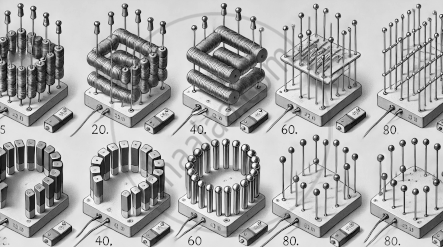
Experiment Steps and Observations:
-
Materials Needed:
- Coils with 20, 40, 60, and 80 turns.
- Battery (2 cells).
- Box of pins.
-
Procedure:
- Wind the coils around an iron core to create electromagnets.
- Connect each coil to the battery one by one.
- Bring each electromagnet near the box of pins and count the pins attracted.
-
Observations:
- 20 turns: Attracts a small number of pins.
- 40 turns: Attracts more pins than the 20-turn coil.
- 60 turns: Attracts even more pins.
- 80 turns: Attracts the most pins.
Result:
| Number of Turns | Pins Attracted |
| 20 | Few pins |
| 40 | More pins |
| 60 | Even more pins |
| 80 | Most pins |
Conclusion:
The strength of the electromagnet increases with the number of turns in the coil. Therefore, the electromagnet with 80 turns is the strongest, followed by those with 60, 40, and 20 turns.
Visual Representation:
The provided image shows the electromagnets with different turns and the pins they attract, illustrating the increasing strength with more turns.
APPEARS IN
संबंधित प्रश्न
Which effect of current can be utilised in detecting a current carrying wire concealed in a wall?
What is Maxwell's corkscrew rule? For what purpose is if used?
A coil is connected to a galvanometer. When the N-pole of magnet is pushed into the coil, the galvanometer deflected to the right. What deflection, if any, is observed when:
the N-pole is removed?
A coil is connected to a galvanometer. When the N-pole of magnet is pushed into the coil, the galvanometer deflected to the right. What deflection, if any, is observed when:
the S-pole is inserted?
Draw magnetic field lines produced around a straight current carrying conductor passing through a cardboard. How will the strength of the magnetic field change when the point where magnetic field is to be determined is moved away from the conductor?
Identify the given figure, write the labels of it.
A soft iron bar is introduced inside the current-carrying solenoid. The magnetic field inside the solenoid ____________.
Boojho made an electromagnet by winding 50 turns of wire over an iron screw. Paheli also made an electromagnet by winding 100 turns over a similar iron screw. Which electromagnet will attract more pins? Give reason.
An electric bell contains an ______, consisting of coils of insulated wire wound around
iron rods.
A rectangular loop ABCD carrying a current I is situated near a straight conductor XY, such that the conductor is parallel to the side AB of the loop and is in the plane of the loop. If a steady current I is established in the conductor as shown, the conductor XY will ______.

