Advertisements
Advertisements
प्रश्न
Explain the magnetic field created by a current around a conductor from the figure.
Advertisements
उत्तर
- Consider a circuit connected as shown in the figure.

- A cardboard is placed around a thick copper wire. A magnetic needle is used to check the magnetic field around the wire.
- When a large current flows through the thick wire, the magnetic needle shows deflection. At different points on the cardboard, the needle points in different directions.
- When joined the directions shown by the needle, the lines formed indicate that the magnetic field produced around a current-carrying conductor is in the form of concentric circles.
- The deflection in the needle changes according to the current in the conductor. For a given current, if we move the compass needle away from the wire, its deflection decreases.
- The direction of the magnetic field formed around the conductor depends on the direction of the current and is given by the right-hand thumb rule.
- If the thumb of the right hand indicates the direction of the current then, the curled fingers indicate the direction of the magnetic field formed.
APPEARS IN
संबंधित प्रश्न
Will the compass needle show deflection when the switch in the circuit shown by figure is closed?

An electromagnet does not attract a piece of iron.
Fill in the following blank with suitable words:
If a coil is viewed from one end and the current flows in an anticlockwise direction, then this end is a ........... pole.
Fill in the following blank with suitable words:
If a coil is viewed from one end, and the current flows in a clockwise direction, then this end is a ........... pole.
Describe some experiment to show that the magnetic field is associated with an electric current.
Name one device which works on the magnetic effect of current.
What device reverses the current?
The north pole of a long bar magnet was pushed slowly into a short solenoid connected to a galvanometer. The magnet was held stationary for a few seconds with the north pole in the middle of the solenoid and then withdrawn rapidly. The maximum deflection of the galvanometer was observed when the magnet was ______.
If fuse of 250 mA, 500 mA, 1 A, 5 A and 10 A were available, which one would be the most suitable for protecting an amplifier rated at 240 V, 180 W?
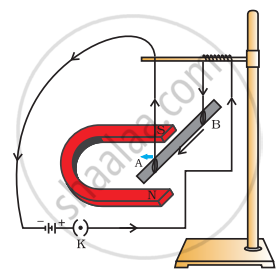
In the Activity shown below, how do we think the displacement of rod AB will be affected if
- current in rod AB is increased
- a stronger horse-shoe magnet is used
- length of the rod AB is increased?
|
Observe the following diagram and choose the correct alternative:

Read the given passage and answer the following questions:
The home electrical connection consists of ‘live’, ‘neutral’ and ‘earth’ wires. The ‘live’ and the ‘neutral’ wires have potential difference of 220 V. The ‘earth’ is connected to ground. Due to a fault in the equipment or if the plastic coating on the ‘live’ and the ‘neutral’ wires gives a way the two wires come in contact with each other and a large current flows through it producing heat. If any inflammable material (such as wood, cloth, plastic, etc.) exists around that place it can catch fire. Therefore a fuse wire is used as a precautionary measure.
- Name the two wires having potential difference of 220 V.
- What is a short circuit?
- Write the function of a fuse.
If the key in the given arrangement is taken out (the circuit is made open) and magnetic field lines are drawn over the horizontal plane ABCD, the lines are ____________.

Magnetic effect of current was discovered by ______.
Unscramble the following words:
HTRCO
Edison used a ______ wire coil is a vacuum glass and discovered the first electric bulb in 1879.
______ cells cannot be recharged after use.
The figure given below shows the magnetic field around the conductor. Study it and answer the questions:

- What changes are caused by increasing current?
- What do you see when the magnetic needle is kept a little away from the wire?
- In the second part of the figure, the iron filings arrange themselves in a circular manner around the wire. Why does this happen?
Make four electromagnets with 20, 40, 60 and 80 turns. Connect them one by one to a battery of 2 cells. Bring the electromagnet near a box of pins. Count the number of pins attracted by it. Compare the strengths of the electromagnets.
