Advertisements
Advertisements
प्रश्न
Paheli does not have a night lamp in her room. She covered the bulb of her room with a towel at the night to get dim light. Has she taken the right step? Give one reason to justify your answer.
Advertisements
उत्तर
No, the towel may burn due to the heat produced by the bulb. Besides, it will also result in the wastage of electric energy. She could have used a lamp shade.
APPEARS IN
संबंधित प्रश्न
Describe some experiment to show that the magnetic field is associated with an electric current.
What is Maxwell's corkscrew rule? For what purpose is if used?
How should the electric lamps in a building be connected so that the switching on or off in a room has no effect on other lamps in the same building?
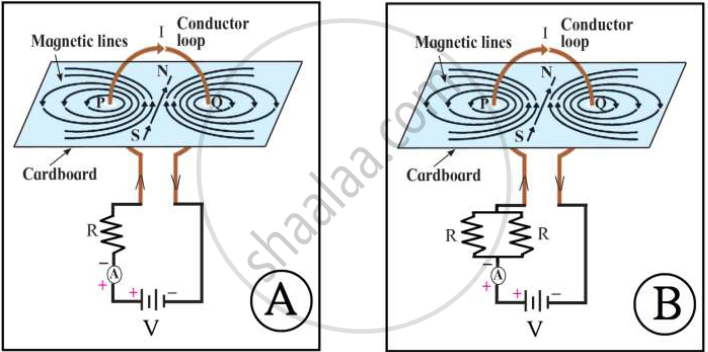
Write the correct option by observing the figures.
What is the function of a split ring in an electric motor?
Observe the following diagram and choose the correct alternative:

(b) State whether the following statements are true or false:
(i) Magnetic poles exist in pairs.
Read the given passage and answer the following questions:
The home electrical connection consists of ‘live’, ‘neutral’ and ‘earth’ wires. The ‘live’ and the ‘neutral’ wires have potential difference of 220 V. The ‘earth’ is connected to ground. Due to a fault in the equipment or if the plastic coating on the ‘live’ and the ‘neutral’ wires gives a way the two wires come in contact with each other and a large current flows through it producing heat. If any inflammable material (such as wood, cloth, plastic, etc.) exists around that place it can catch fire. Therefore a fuse wire is used as a precautionary measure.
- Name the two wires having potential difference of 220 V.
- What is a short circuit?
- Write the function of a fuse.
Identify the given figure, write the labels of it.
A wire with green insulation is usually the live wire of an electric supply.
