Advertisements
Advertisements
प्रश्न
An electromagnet does not attract a piece of iron.
पर्याय
True
False
Advertisements
उत्तर
This statement is False.
Explanation:
- The working of an electromagnet is based on the magnetic effect of electric current.
- When current passes through it, an electromagnet behaves as a magnet, attracting a piece of iron.
APPEARS IN
संबंधित प्रश्न
When the current is switched on through a wire, a compass needle kept nearby gets deflected from its north-south position. Explain.
Fill in the following blank with suitable words:
The magnetic effect of a coil can be increased by increasing the number of ........... increasing the ........... or inserting an ........... core.
Fill in the following blank with suitable words:
If a coil is viewed from one end and the current flows in an anticlockwise direction, then this end is a ........... pole.
The direction of current flowing in the coil of an electromagnet at its two ends X and Y are as shown below:
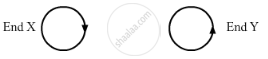
What is the polarity of end X?
What is the polarity of end Y?
Name and state the rule which you have used to determine the polarities.
The north pole of a long bar magnet was pushed slowly into a short solenoid connected to a galvanometer. The magnet was held stationary for a few seconds with the north pole in the middle of the solenoid and then withdrawn rapidly. The maximum deflection of the galvanometer was observed when the magnet was ______.
A coil is connected to a galvanometer. When the N-pole of magnet is pushed into the coil, the galvanometer deflected to the right. What deflection, if any, is observed when:
the S-pole is inserted?
How should the electric lamps in a building be connected so that the switching on or off in a room has no effect on other lamps in the same building?
Paheli does not have a night lamp in her room. She covered the bulb of her room with a towel at the night to get dim light. Has she taken the right step? Give one reason to justify your answer.
Edison used a ______ wire coil is a vacuum glass and discovered the first electric bulb in 1879.
