Advertisements
Advertisements
प्रश्न
An electric bell has an electromagnet.
पर्याय
True
False
Advertisements
उत्तर
This statement is True.
Explanation:
An electric bell has a piece of iron wound by a coil. When current passes through this coil, it behaves as an electromagnet.

APPEARS IN
संबंधित प्रश्न
Name the scientist who discovered the magnetic effect of current.
When the switch S is closed in the figure given below, the pointer of the galvanometer moves to the right.
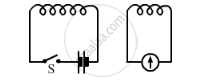
If S is kept closed, will the pointer:
(a) return to zero?
(b) stay over on the right?
(c) move to the left and stay there
(d) move to and fro until S is opened
The north pole of a long bar magnet was pushed slowly into a short solenoid connected to a galvanometer. The magnet was held stationary for a few seconds with the north pole in the middle of the solenoid and then withdrawn rapidly. The maximum deflection of the galvanometer was observed when the magnet was ______.
A coil is connected to a galvanometer. When the N-pole of magnet is pushed into the coil, the galvanometer deflected to the right. What deflection, if any, is observed when:
the magnet is a rest in the coil?
If fuse of 250 mA, 500 mA, 1 A, 5 A and 10 A were available, which one would be the most suitable for protecting an amplifier rated at 240 V, 180 W?
(b) State whether the following statements are true or false:
(i) Magnetic poles exist in pairs.
(ii) Global warming is a desirable aspect of the intensified greenhouse effect.
Unscramble the following words:
HTRCO
______ cells cannot be recharged after use.
The figure given below shows the magnetic field around the conductor. Study it and answer the questions:

- What changes are caused by increasing current?
- What do you see when the magnetic needle is kept a little away from the wire?
- In the second part of the figure, the iron filings arrange themselves in a circular manner around the wire. Why does this happen?
Make four electromagnets with 20, 40, 60 and 80 turns. Connect them one by one to a battery of 2 cells. Bring the electromagnet near a box of pins. Count the number of pins attracted by it. Compare the strengths of the electromagnets.
