Advertisements
Advertisements
प्रश्न
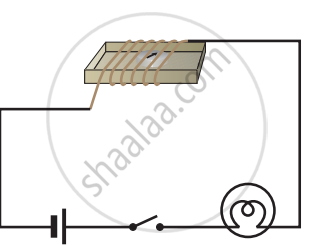
Set up the circuit shown in Figure again. Move the key to ‘ON’ position and watch carefully in which direction the compass needle gets deflected. Switch ‘OFF’ the current. Now keeping rest of the circuit intact, reverse the connections at the terminal of the cell. Again switch ‘on’ the current. Note the direction in which the needle gets deflected. Think of an explanation.
Advertisements
उत्तर

- Set up the Circuit:
- Connect the components as shown in the figure: battery, switch, wire wound around cardboard, and a compass.
- Turn the Switch 'ON':
- Close the switch to 'ON'.
- Observe and note the direction of the compass needle deflection.
- Turn the Switch 'OFF':
- Open the switch to 'OFF'.
- Reverse Battery Connections:
- Swap the positive and negative terminals of the battery.
- Turn the Switch 'ON' Again:
- Close the switch to 'ON'.
- Observe and note the direction of the compass needle deflection again.
- Explanation:
- The compass needle deflects due to the magnetic field created by the current.
- Reversing the battery connections reverses the current direction, thus reversing the magnetic field and the needle's deflection direction.
APPEARS IN
संबंधित प्रश्न
The accompanying figure shows some electrical appliances connected in a circuit in a house. Answer the following questions.

- By which method are the appliances connected?
- What must be the potential difference across individual appliances?
- Will the current passing through each appliance be the same? Justify your answer.
- Why are the domestic appliances connected in this way?
- If the T.V. stops working, will the other appliances also stop working? Explain your answer.
A battery is to be formed by joining 3 dry cells with connecting wires. Show how will you connect the wires by drawing a diagram.
Nowadays MCBs are used in homes, for stop the current in the circuit which suddenly increases.
Draw the circuit diagram for the series connection.
Rahul wants to make an electric circuit. He has a bulb, two wires, a safety pin, and a piece of copper. He does not have any electric cell or battery. Suddenly he gets some idea. He uses lemon instead of a battery and makes a circuit. Will the bulb glow?
Higher Order Question
A student made a circuit by using an electric cell, a switch, a torch bulb (fitted in the bulb holder), and copper connecting wires. When he turned on the switch, the torch bulb did not glow at all. The student checked the circuit and found that all the wire connections were tight.
- What could be the possible reason for the torch bulb not glowing even when the circuit appears to be complete?
What is electric circuit?
In an electrical circuit two resistors of 2 Ω and 4 Ω respectively are connected in series to a 6 V battery. The heat dissipated by the 4 Ω resistor in 5 s will be
In an electric circuit, the current starts from ______.
