Advertisements
Advertisements
प्रश्न
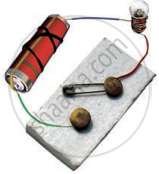
Will the bulb glow in the circuit shown in the following figure? Explain.
Advertisements
उत्तर
No, the bulb will not glow in this circuit because the switch is open and the circuit is incomplete. Current flows only in a closed circuit.
APPEARS IN
संबंधित प्रश्न
Redraw the circuit of question 1, putting in an ammeter to measure the current through the resistors and a voltmeter to measure the potential difference across the 12 Ω resistors. What would be the readings in the ammeter and the voltmeter?
Draw circuit symbols for
an open switch
Explain with the help of a labelled circuit diagram how you will find the resistance of a combination of three resistors, or resistance R1, R2 and R3, joined in parallel. Also mention how you will connect the ammeter and the voltmeter in the circuit when measuring the current in the circuit and the potential difference across one of the three resistors of the combination.
Tell the odd one out. Give a proper explanation.
Name the instrument used to control current in an electric circuit.
Explain the following:
Closed circuit
Choose the statement which is not correct in the case of an electric fuse.
Overloading of electric circuits can lead to short-circuiting.
A complete circuit is left on for several minutes, causing the connecting copper wire to become hot. As the temperature of the wire increases, the electrical resistance of the wire
Assertion: People struck by lightning receive a severe electrical shock.
Reason: Lightning carries very high voltage.
