Advertisements
Advertisements
प्रश्न
Draw a circuit diagram of an electric circuit containing a cell, a key, an ammeter, a resistor of 2 Ω in series with a combination of two resistors (4 Ω each) in parallel and a voltmeter across the parallel combination. Will the potential difference across the 2 Ω resistor be the same as that across the parallel combination of 4 Ω resistors? Give reason.
Advertisements
उत्तर

Yes, the potential difference across the 2 Ω resistor will be the same as that across the parallel combination of 4 Ω resistors because net resistance of parallel combination
= `(4 xx 4)/(4 + 4)`
= 2 Ω
and current across 2 Ω and parallel combination is the same.
APPEARS IN
संबंधित प्रश्न
How does the short circuit form?
A battery is to be formed by joining 3 dry cells with connecting wires. Show how will you connect the wires by drawing a diagram.
Draw a neat diagram showing a closed electric circuit.
Find the odd one out and give its explanation.
What is the potential difference?
Write scientific reason.
It is beneficial to carry electrical energy in AC form as it is carried over long distances.
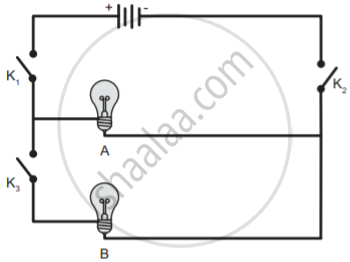
In the given circuit diagram, which of the given switch(s) should be closed. So that only bulb A glows.
Rahul wants to make an electric circuit. He has a bulb, two wires, a safety pin, and a piece of copper. He does not have any electric cell or battery. Suddenly he gets some idea. He uses lemon instead of a battery and makes a circuit. Will the bulb glow?
In which among the following circuits does the bulb glow?
Higher Order Question
A student made a circuit by using an electric cell, a switch, a torch bulb (fitted in the bulb holder), and copper connecting wires. When he turned on the switch, the torch bulb did not glow at all. The student checked the circuit and found that all the wire connections were tight.
- What could be the possible reason for the torch bulb not glowing even when the circuit appears to be complete?
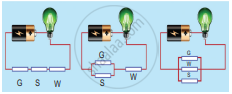
Study the three electric circuits below. Each of them has a glass rod (G), a steel rod (S), and a wooden rod (W).
In which of the electric circuits would the bulb not light up.
Three bulbs are connected end to end from the battery. This connection is called _______.
State whether true or false. If false, correct the statement.
Ammeter is connected in parallel in any electric circuit.
The wiring in a house consists of ______ circuits.
Assertion: In an open circuit, the current passes from one terminal of the electric cell to another.
Reason: Generally, the metal disc of a cell acts as a positive terminal.
In an electrical circuit three incandescent bulbs A, B and C of rating 40 W, 60 W and 100 W respectively are connected in parallel to an electric source. Which of the following is likely to happen regarding their brightness?
In an electrical circuit two resistors of 2 Ω and 4 Ω respectively are connected in series to a 6 V battery. The heat dissipated by the 4 Ω resistor in 5 s will be
In an electric circuit a fuse is a ______ ______ to prevent possible fire.
What are the essential components of an electric circuit?
