Advertisements
Advertisements
प्रश्न
What is the potential difference?
Advertisements
उत्तर
The potential difference is the difference in the electric potential of two different points.
APPEARS IN
संबंधित प्रश्न
Draw a schematic diagram of a circuit consisting of a battery of three cells of 2 V each, a 5 Ω resistor, an 8 Ω resistor, and a 12 Ω resistor, and a plug key, all connected in series.
Redraw the circuit of question 1, putting in an ammeter to measure the current through the resistors and a voltmeter to measure the potential difference across the 12 Ω resistors. What would be the readings in the ammeter and the voltmeter?
Draw circuit symbols for
fixed resistance
Tell the odd one out. Give a proper explanation.
Observe the following figure which bulb get fuse?

The following figure shows the symbols for components used in the accompanying electrical circuit. Place them at proper places and complete the circuit.
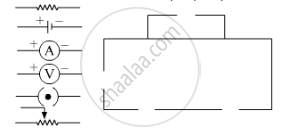
Which law can you prove with the help of above circuit?
Resistances R1, R2, R3 and R4 are connected as shown in the figure. S1 and S2 are two keys. Discuss the current flowing in the circuit in the following cases.
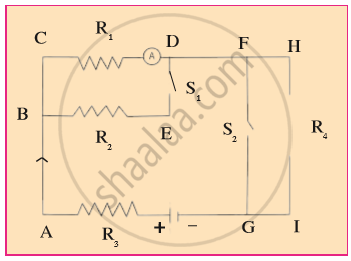
- Both S1 and S2 are closed.
- Both S1 and S2 are open.
- S1 is closed but S2 is open.
A battery is to be formed by joining 3 dry cells with connecting wires. Show how will you connect the wires by drawing a diagram.
In an electric circuit, a battery and a bulb have been connected and the battery consists of two cells of equal potential difference. If the bulb is not glowing, then which tests will you perform in order to find out the reason for the bulb not glowing?
Match the column ‘A’ with column ‘B’.
|
Column ‘A’
|
Column ‘B’ |
|
(1) Eka - boron
|
(a) Germanium
|
|
(2) Eka - Aluminium
|
(b) Scandium
|
|
(3) Eka - Silicon
|
(c) Gallium |
Draw a neat diagram showing a closed electric circuit.
Draw a neat diagram showing a open electric circuit.
Name the instrument used to control current in an electric circuit.
Explain the following:
Closed circuit
How much is the potential difference between live and neutral wires?
Write scientific reason.
It is beneficial to carry electrical energy in AC form as it is carried over long distances.
Flow of electricity through a closed circuit is _____.
The switch is used to close or open an electric circuit.
In which of the following circuits are the bulb connected in series?
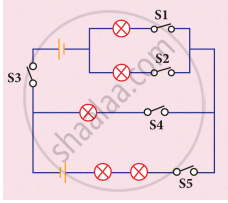
Study the electric circuit below. Which of the following switches should be closed so that only two bulbs will light up
Fuse is
_____ has a thin metallic filament that melts and breaks the connection when the circuit is overheated.
Assertion: People struck by lightning receive a severe electrical shock.
Reason: Lightning carries very high voltage.
What is electric circuit?
In a simple circuit, why does the bulb glow when you close the switch?
Assertion: In an open circuit, the current passes from one terminal of the electric cell to another.
Reason: Generally, the metal disc of a cell acts as a positive terminal.
The rate of flow of electric charges in a circuit is called ______.
______ is a kind of fish which is able to produce an electric current.
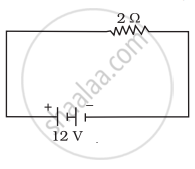
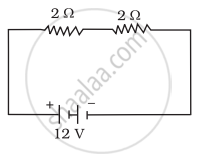
In the following circuits (Figure), heat produced in the resistor or combination of resistors connected to a 12 V battery will be
 |
 |
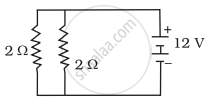 |
| (i) | (ii) | (iii) |
Choose the statement which is not correct in the case of an electric fuse.
Name the device used these days in place of electric fuses in electrical circuits.
In an electric circuit a fuse is a ______ ______ to prevent possible fire.
Match the following
| 1. | Insulator | a. | Coulomb |
| 2. | Conductor | b. | Electric circuit |
| 3. | Closed path | c. | Copper |
| 4. | Electric charge | d. | Rubber |
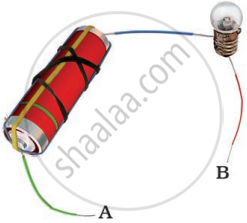
In the following arrangement shown in the following figure, the bulb will not glow if the ends A and B are connected with
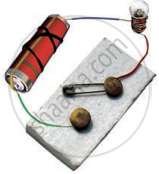
Will the bulb glow in the circuit shown in the following figure? Explain.
Boojho has a cell and a single piece of connecting wire. Without cutting the wire in two, will he be able to make the bulb glow? Explain with the help of a circuit diagram.
Write a short note on the different electrical circuits.
