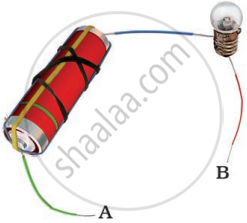
Advertisements
Advertisements
प्रश्न
What is the potential difference?
Advertisements
उत्तर
The potential difference is the difference in the electric potential of two different points.
APPEARS IN
संबंधित प्रश्न
What do the following symbols mean in circuit diagrams?
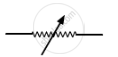
What is a circuit diagram
Tell the odd one out. Give a proper explanation.
How does the short circuit form?
Who will spend more electrical energy? 500 W TV Set in 30 mins, or 600 W heater in 20 mins?
A battery is to be formed by joining 3 dry cells with connecting wires. Show how will you connect the wires by drawing a diagram.
Match the column ‘A’ with column ‘B’.
|
Column ‘A’
|
Column ‘B’ |
|
(1) Eka - boron
|
(a) Germanium
|
|
(2) Eka - Aluminium
|
(b) Scandium
|
|
(3) Eka - Silicon
|
(c) Gallium |
What do you understand by the open electric circuit?
Name the instrument used to control current in an electric circuit.
In any electric circuit, when the switch is on and the current flows through it why do the wire, switches, bulb or devices become hot?
The unit of electrical power is _______.
How much is the potential difference between live and neutral wires?
What is the use of earthing wire?
______ is the device used to close or open an electric circuit.
The switch is used to close or open an electric circuit.
Draw the circuit diagram for the series connection.
In the circuit diagram below, 10 units of electric charge move past point x every second What is the current in the circuit ______.
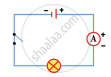
In the circuit shown, which switches (L,M or N) must be closed to light up the bulb?
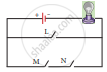
Study the electric circuit below. Which of the following switches should be closed so that only two bulbs will light up
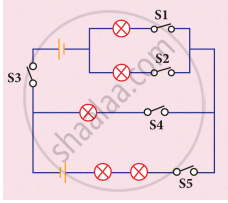
Which of the following a simple circuit must-have?
Three bulbs are connected end to end from the battery. This connection is called _______.
In a simple circuit, why does the bulb glow when you close the switch?
The wiring in a house consists of ______ circuits.
What is the role of the earth wire in domestic circuits?
A device that is used to break an electric circuit is called ______.
The rate of flow of electric charges in a circuit is called ______.
In the following circuits (Figure), heat produced in the resistor or combination of resistors connected to a 12 V battery will be
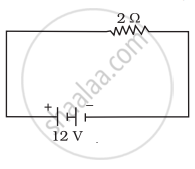 |
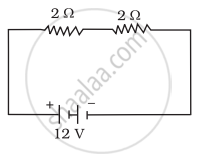 |
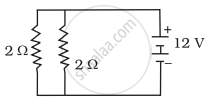 |
| (i) | (ii) | (iii) |
A child has drawn the electric circuit to study Ohm’s law as shown in Figure. His teacher told that the circuit diagram needs correction. Study the circuit diagram and redraw it after making all corrections.

In an electric circuit, the current starts from ______.
Choose the statement which is not correct in the case of an electric fuse.
Name the device used these days in place of electric fuses in electrical circuits.
Our body is a ______ of electricity.
In the following arrangement shown in the following figure, the bulb will not glow if the ends A and B are connected with