Advertisements
Advertisements
प्रश्न
Match the column ‘A’ with column ‘B’.
|
Column ‘A’
|
Column ‘B’ |
|
(1) Eka - boron
|
(a) Germanium
|
|
(2) Eka - Aluminium
|
(b) Scandium
|
|
(3) Eka - Silicon
|
(c) Gallium |
Advertisements
उत्तर
|
Column ‘A’
|
Column ‘B’
|
|
(1) Eka - boron
|
(b) Scandium |
|
(2) Eka - Aluminium
|
(c) Gallium |
|
(3) Eka - Silicon
|
(a) Germanium |
APPEARS IN
संबंधित प्रश्न
What do the following symbols mean in circuit diagrams?
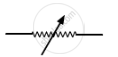
Draw circuit symbols for
A closed switch
What is a circuit diagram
Draw a circuit diagram to show how 3 bulbs can be lit from a battery so that 2 bulbs are controlled by the same switch the third bulb has its own switch.
Explain with the help of a labelled circuit diagram how you will find the resistance of a combination of three resistors, or resistance R1, R2 and R3, joined in parallel. Also mention how you will connect the ammeter and the voltmeter in the circuit when measuring the current in the circuit and the potential difference across one of the three resistors of the combination.
Tell the odd one out. Give a proper explanation.
In an electric circuit, electron flow a from of point of ______ potential to the point of ______ potential.
A battery is to be formed by joining 3 dry cells with connecting wires. Show how will you connect the wires by drawing a diagram.
Distinguish between a closed circuit and an open circuit, with the use of suitable labelled diagrams.
Write the condition required for a circuit to be a closed circuit.
Name the instrument used to control current in an electric circuit.
Explain the following:
Closed circuit
Nowadays MCBs are used in homes, for stop the current in the circuit which suddenly increases.
What is the use of earthing wire?
______ is the device used to close or open an electric circuit.
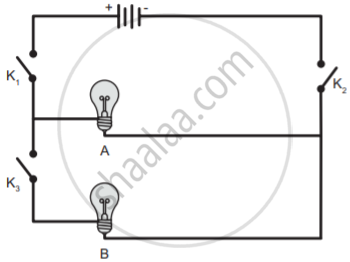
In the given circuit diagram, which of the given switch(s) should be closed. So that only bulb A glows.
Rahul wants to make an electric circuit. He has a bulb, two wires, a safety pin, and a piece of copper. He does not have any electric cell or battery. Suddenly he gets some idea. He uses lemon instead of a battery and makes a circuit. Will the bulb glow?
In the circuit diagram below, 10 units of electric charge move past point x every second What is the current in the circuit ______.
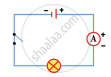
Draw the circuit diagram for the following series connection
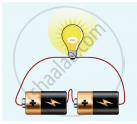
Fuse is
State whether true or false. If false, correct the statement.
Ammeter is connected in parallel in any electric circuit.
Explain about domestic electric circuits. (circuit diagram not required)
A device that is used to break an electric circuit is called ______.
What are the types of electric circuits?
A child has drawn the electric circuit to study Ohm’s law as shown in Figure. His teacher told that the circuit diagram needs correction. Study the circuit diagram and redraw it after making all corrections.

In an electric circuit, the current starts from ______.
Choose the statement which is not correct in the case of an electric fuse.
In an electric circuit a fuse is a ______ ______ to prevent possible fire.
Observe the circuit given:
1. Would any of the bulbs glow when the switch is in the ‘OFF’ position?
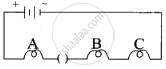
2. What will be the order in which the bulbs A, B, and C will glow when the switch is moved to the ‘ON’ position?

In the above circuit, if the current reading in the ammeter A is 2A, what would be the value of R1?
The ______ is a species of fish that can give electric shocks of up to six hundred fifty watts of electricity.
In the following arrangement shown in the following figure, the bulb will not glow if the ends A and B are connected with
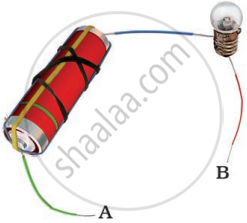
Will the bulb glow in the circuit shown in the following figure? Explain.
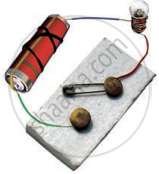
Overloading of electric circuits can lead to short-circuiting.
Assertion: People struck by lightning receive a severe electrical shock.
Reason: Lightning carries very high voltage.
Set up the circuit shown in Figure again. Move the key to ‘ON’ position and watch carefully in which direction the compass needle gets deflected. Switch ‘OFF’ the current. Now keeping rest of the circuit intact, reverse the connections at the terminal of the cell. Again switch ‘on’ the current. Note the direction in which the needle gets deflected. Think of an explanation.