Advertisements
Advertisements
प्रश्न
The accompanying figure shows some electrical appliances connected in a circuit in a house. Answer the following questions.

- By which method are the appliances connected?
- What must be the potential difference across individual appliances?
- Will the current passing through each appliance be the same? Justify your answer.
- Why are the domestic appliances connected in this way?
- If the T.V. stops working, will the other appliances also stop working? Explain your answer.
Advertisements
उत्तर
- The appliances are connected in parallel.
- The potential difference between all appliances is the same with a parallel connection.
- No, because each appliance has a different load (resistance), the current passing through them will differ.
- Domestic appliances are connected in parallel because the potential difference remains constant.
- No, the other devices will continue working since the current passing through them follows separate routes.
APPEARS IN
संबंधित प्रश्न
Resistances R1, R2, R3 and R4 are connected as shown in the figure. S1 and S2 are two keys. Discuss the current flowing in the circuit in the following cases.
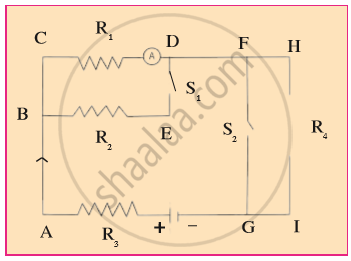
- Both S1 and S2 are closed.
- Both S1 and S2 are open.
- S1 is closed but S2 is open.
What do you understand by the closed electric circuit
What do you understand by the open electric circuit?
What is the use of earthing wire?
Higher Order Question
A student made a circuit by using an electric cell, a switch, a torch bulb (fitted in the bulb holder), and copper connecting wires. When he turned on the switch, the torch bulb did not glow at all. The student checked the circuit and found that all the wire connections were tight.
- What could be the possible reason for the torch bulb not glowing even when the circuit appears to be complete?
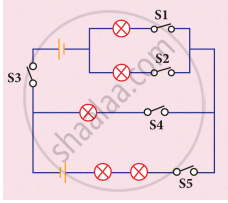
Study the electric circuit below. Which of the following switches should be closed so that only two bulbs will light up
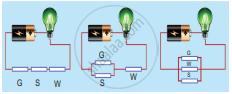
Study the three electric circuits below. Each of them has a glass rod (G), a steel rod (S), and a wooden rod (W).
In which of the electric circuits would the bulb not light up.
Assertion: People struck by lightning receive a severe electrical shock.
Reason: Lightning carries very high voltage.
The wiring in a house consists of ______ circuits.
In a circuit, if the key is in open (off) condition, then electricity will not flow.
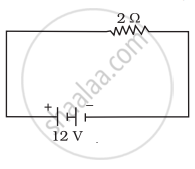
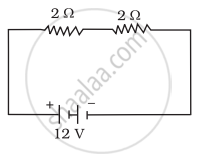
In the following circuits (Figure), heat produced in the resistor or combination of resistors connected to a 12 V battery will be
 |
 |
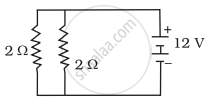 |
| (i) | (ii) | (iii) |
In an electrical circuit three incandescent bulbs A, B and C of rating 40 W, 60 W and 100 W respectively are connected in parallel to an electric source. Which of the following is likely to happen regarding their brightness?
In an electrical circuit two resistors of 2 Ω and 4 Ω respectively are connected in series to a 6 V battery. The heat dissipated by the 4 Ω resistor in 5 s will be
When an electric current flows through a copper wire AB as shown in the following figure, the wire

Three bulbs A, B, C are connected in a circuit as shown in the following figure. When the switch is ‘ON’
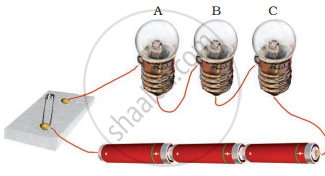
Observe the circuit given:
1. Would any of the bulbs glow when the switch is in the ‘OFF’ position?
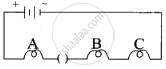
2. What will be the order in which the bulbs A, B, and C will glow when the switch is moved to the ‘ON’ position?

In the above circuit, if the current reading in the ammeter A is 2A, what would be the value of R1?
Paheli is running short of connecting wires. To complete an electric circuit, she may use a ______.
