Advertisements
Advertisements
प्रश्न
Choose the statement which is not correct in the case of an electric fuse.
पर्याय
Fuses are inserted in electric circuits of all buildings.
There is a maximum limit on the current which can safely flow through the electric circuits.
There is a minimum limit on the current which can safely flow in the electric circuits.
If a proper fuse is inserted in a circuit it will blow off if current exceeds the safe limit.
Advertisements
उत्तर
There is a minimum limit on the current which can safely flow in the electric circuits.
Explanation:
In an electric fuse, there is a maximum limit on the current that can safely flow through the circuit. If the current exceeds this limit, the fuse will blow and break the circuit, preventing damage to electrical components. However, there is no minimum limit on the current that can flow safely in the circuit. The fuse is designed to protect against excessive current, not to regulate a minimum current.
APPEARS IN
संबंधित प्रश्न
Draw circuit symbols for variable resistance
In any electric circuit, when the switch is on and the current flows through it why do the wire, switches, bulb or devices become hot?
Right or wrong sentence.
Increasing the current passing through the wire decreases the magnetic field intensity.
In the circuit diagram below, 10 units of electric charge move past point x every second What is the current in the circuit ______.

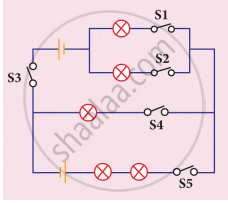
Study the electric circuit below. Which of the following switches should be closed so that only two bulbs will light up
When a circuit is open, _____ cannot pass through it.
The rate of flow of electric charges in a circuit is called ______.
In an electric circuit a fuse is a ______ ______ to prevent possible fire.
Will the bulb glow in the circuit shown in the following figure? Explain.

Overloading of electric circuits can lead to short-circuiting.
