Advertisements
Advertisements
Question
Choose the statement which is not correct in the case of an electric fuse.
Options
Fuses are inserted in electric circuits of all buildings.
There is a maximum limit on the current which can safely flow through the electric circuits.
There is a minimum limit on the current which can safely flow in the electric circuits.
If a proper fuse is inserted in a circuit it will blow off if current exceeds the safe limit.
Advertisements
Solution
There is a minimum limit on the current which can safely flow in the electric circuits.
Explanation:
In an electric fuse, there is a maximum limit on the current that can safely flow through the circuit. If the current exceeds this limit, the fuse will blow and break the circuit, preventing damage to electrical components. However, there is no minimum limit on the current that can flow safely in the circuit. The fuse is designed to protect against excessive current, not to regulate a minimum current.
APPEARS IN
RELATED QUESTIONS
Draw circuit symbols for
a cell
Observe the following figure which bulb get fuse?

Answer the following question.
With the help of a suitable circuit diagram prove that the reciprocal of the equivalent resistance of a group of resistances joined in parallel is equal to the sum of the reciprocals of the individual resistances.
Draw a neat diagram showing a open electric circuit.
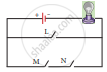
In the circuit shown, which switches (L,M or N) must be closed to light up the bulb?
State whether true or false. If false, correct the statement.
Ammeter is connected in parallel in any electric circuit.
In an electrical circuit three incandescent bulbs A, B and C of rating 40 W, 60 W and 100 W respectively are connected in parallel to an electric source. Which of the following is likely to happen regarding their brightness?
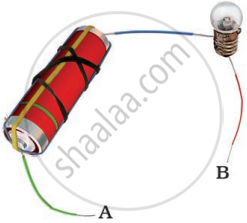
In the following arrangement shown in the following figure, the bulb will not glow if the ends A and B are connected with
Overloading of electric circuits can lead to short-circuiting.
