Advertisements
Advertisements
Question
Find the odd one out and give its explanation.
Options
Temperature
Conduction
Convection
Radiation
Advertisements
Solution
Temperature
Explanation-
Temperature is a degree of hotness while conduction, convection, and radiation are modes of heat transfer.
APPEARS IN
RELATED QUESTIONS
Draw circuit symbols for
fixed resistance
Draw circuit symbols for variable resistance
Draw circuit symbols for
an open switch
Tell the odd one out. Give a proper explanation.
Who will spend more electrical energy? 500 W TV Set in 30 mins, or 600 W heater in 20 mins?
The accompanying figure shows some electrical appliances connected in a circuit in a house. Answer the following questions.

- By which method are the appliances connected?
- What must be the potential difference across individual appliances?
- Will the current passing through each appliance be the same? Justify your answer.
- Why are the domestic appliances connected in this way?
- If the T.V. stops working, will the other appliances also stop working? Explain your answer.
In an electric circuit, electron flow a from of point of ______ potential to the point of ______ potential.
Distinguish between a closed circuit and an open circuit, with the use of suitable labelled diagrams.
Draw a neat diagram showing a open electric circuit.
Explain the following:
Open circuit
Explain the following:
Closed circuit
What is open circuit?
If you touch an electric wire carrying current you get a shock, but if on the same wire the birds sit they do not get any shock/current. Explain why?
Right or wrong sentence.
Increasing the current passing through the wire decreases the magnetic field intensity.
Nowadays MCBs are used in homes, for stop the current in the circuit which suddenly increases.
Write scientific reason.
It is beneficial to carry electrical energy in AC form as it is carried over long distances.
______ is the device used to close or open an electric circuit.
In the circuit diagram below, 10 units of electric charge move past point x every second What is the current in the circuit ______.
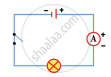
In which of the following circuits are the bulb connected in series?
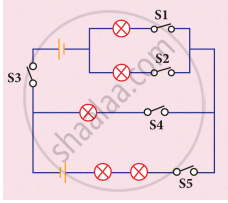
Study the electric circuit below. Which of the following switches should be closed so that only two bulbs will light up
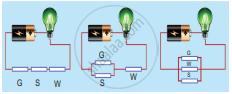
Study the three electric circuits below. Each of them has a glass rod (G), a steel rod (S), and a wooden rod (W).
In which of the electric circuits would the bulb not light up.
Which of the following a simple circuit must-have?
_____ has a thin metallic filament that melts and breaks the connection when the circuit is overheated.
Three bulbs are connected end to end from the battery. This connection is called _______.
In a simple circuit, why does the bulb glow when you close the switch?
What is the role of the earth wire in domestic circuits?
Explain about domestic electric circuits. (circuit diagram not required)
A device that is used to break an electric circuit is called ______.
______ is a kind of fish which is able to produce an electric current.
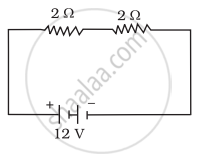
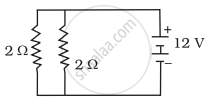
In the following circuits (Figure), heat produced in the resistor or combination of resistors connected to a 12 V battery will be
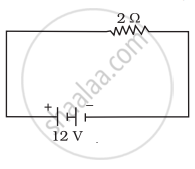 |
 |
 |
| (i) | (ii) | (iii) |
In an electrical circuit two resistors of 2 Ω and 4 Ω respectively are connected in series to a 6 V battery. The heat dissipated by the 4 Ω resistor in 5 s will be
Choose the statement which is not correct in the case of an electric fuse.
Our body is a ______ of electricity.

In the above circuit, if the current reading in the ammeter A is 2A, what would be the value of R1?
Write a short note on the different electrical circuits.
