Advertisements
Advertisements
Question
Find the odd one out and give its explanation.
Options
Boiler
Electric stove
Electric bulb
Electric bell
Advertisements
Solution
Electric bell
Explanation-
Others are used to generate heat energy when it becomes hot whereas electric bell do not produce any heat energy.
APPEARS IN
RELATED QUESTIONS
Electric field intensity in free space at a distance ‘r’ outside the charged conducting sphere of radius ‘R’ in terms of surface charge density ‘ a ’ is............................
(a)`sigma / in_0[R/r]^2`
(b)`in_0/sigma[R/r]^2`
(c)`R/r[sigma/in_0]^2`
(d)`R/sigma[r/in_0]^2`
When a bar magnet is pushed towards (or away) from the coil connected to a galvanometer, the pointer in the galvanometer deflects. Identify the phenomenon causing this deflection and write the factors on which the amount and direction of the deflection depends. State the laws describing this phenomenon.
Two circular coils A and B are placed closed to each other. If the current in the coil A is changed, will some current be induced in the coil B? Give reason.
What is electromagnetic induction?
When an electric current is passed through any wire, a magnetic field is produced around it. Then why an electric iron connecting cable does not attract nearby iron objects when electric current switched on through it?
State three ways in which the strength of an electromagnet can be increased.
What is an electromagnet? Describe the construction and working of an electromagnet with the help of a labelled diagram.
Write some of the important uses of electromagnets.
The most suitable material for making the core of an electromagnet is:
(a) soft iron
(b) brass
(c) aluminium
(d) steel
When the magnet shown in the diagram below is moving towards the coil, the galvanometer gives a reading to the right.
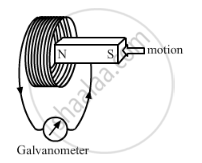
() What is the name of the effect being produced by the moving magnet?
(2) State what happens to the reading shown on the galvanometer when the magnet is moving away from the coil.
(3) The original experiment is repeated. This time the magnet is moved towards the coil at a great speed. State two changes you would notice in the reading on the galvanometer.
A conducting square loop having edges of length 2.0 cm is rotated through 180° about a diagonal in 0.20 s. A magnetic field B exists in the region which is perpendicular to the loop in its initial position. If the average induced emf during the rotation is 20 mV, find the magnitude of the magnetic field.
Figure shows a wire sliding on two parallel, conducting rails placed at a separation l. A magnetic field B exists in a direction perpendicular to the plane of the rails. What force is necessary to keep the wire moving at a constant velocity v?
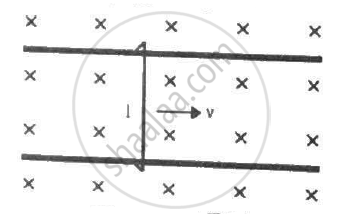
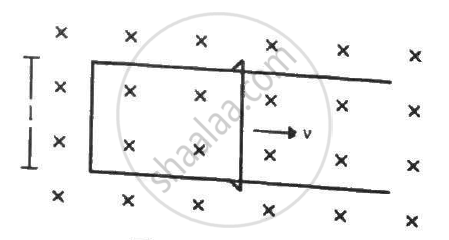
Figure shows a long U-shaped wire of width l placed in a perpendicular magnetic field B. A wire of length l is slid on the U-shaped wire with a constant velocity v towards right. The resistance of all the wires is r per unit length. At t = 0, the sliding wire is close to the left edge of the U-shaped wire. (a) Calculate the force needed to keep the sliding wire moving with a constant velocity v. (b) If the force needed just after t = 0 is F0, find the time at which the force needed will be F0/2.0
Fill in the blanks by writing (i) Only soft iron, (ii) Only steel, (iii) Both soft-iron and steel for the material of core and/or magnet.
Transformer______.
What is an electromagnet?
State the condition at which we say the two coils kept close to each other are perfectly coupled with each other.
Which of the following scientist invented the rule of electromagnetic induction?
State Fleming’s right-hand rule.
A square coil of side 30 cm with 500 turns is kept in a uniform magnetic field of 0.4 T. The plane of the coil is inclined at an angle of 30° to the field. Calculate the magnetic flux through the coil.
An alternating emf of 0.2 V is applied across an L-C-R series circuit having R = 4Q, C = 80µF, and L = 200 mH. At resonance the voltage drop across the inductor is
A layer of atmosphere that reflects medium frequency radio waves which is ineffective during night, is ______.
Ansari Sir was demonstrating an experiment in his class with the setup as shown in the figure below.

A magnet is attached to a spring. The magnet can go in and out of the stationary coil. He lifted the Magnet and released it to make it oscillate through the coil.
Based on your understanding of the phenomenon, answer the following question.
What will be observed when the Magnet starts oscillating through the coil. Explain the reason behind this observation.
For making a strong electromagnet the material of the core should be ______.
Sea turtles return to their birth beach many decades after they were born due to ______.
A conductor of length 50 cm carrying a current of 5 A is placed perpendicular to a magnetic field of induction 2×10 -3T. Find the force on the conductor.
Which of the following phenomena makes use of electromagnetic induction?
AB is a coil of copper wire having a large number of turns. The ends of the coil are connected with a galvanometer as shown. When the north pole of a strong bar magnet is moved towards end B of the coil, a deflection is observed in the galvanometer.

- State the reason for using galvanometer in the activity and why does its needle deflects momentarily when magnet is moved towards the coil.
- What would be observed in the galvanometer in a situation when the coil and the bar magnet both move with the same speed in the same direction? Justify your answer.
- State the conclusion that can be drawn from this activity.
Will there be any change in the momentary deflection in the galvanometer if number of turns in the coil is increased and a more stronger magnet is moved towards the coil?
OR
What is electromagnetic induction? What is observed in the galvanometer when a strong bar magnet is held stationary near one end of a coil of large number of turns? Justify your answer.
An expression for oscillating electric field in a plane electromagnetic wave is given as Ez = 300 sin(5π × 103x - 3π × 1011t)Vm-1 Then, the value of magnetic field amplitude will be ______. (Given: speed of light in Vacuum c = 3 × 10⁸ ms-1)
How were electricity and magnetism considered for a long time?
Which scientists established in the early nineteenth century that electricity and magnetism are related?
What do moving electric charges produce?
What can produce a current in a coil even when the coil does not move?
What change can produce a current in a stationary conductor?
Which change in the current of a nearby solenoid coil can produce an induced current?
What is produced when a magnet moves towards or away from a coil?
What is a solenoid?
