Advertisements
Advertisements
Question
A conducting square loop having edges of length 2.0 cm is rotated through 180° about a diagonal in 0.20 s. A magnetic field B exists in the region which is perpendicular to the loop in its initial position. If the average induced emf during the rotation is 20 mV, find the magnitude of the magnetic field.
Advertisements
Solution
Given:-
Induced emf, e = 20 mV = 20 × 10−3 V
Area of the loop, A = (2 × 10⁻²)2 = 4 × 10⁻⁴ m2
Time taken to rotate the loop, Δt = 0.2 s
The average induced emf is given by
\[e = - \frac{∆ \phi}{∆ t} = \frac{\phi_i - \phi_f}{t}\]
\[\phi = \overrightarrow{B} . \overrightarrow{A} = BA\cos\theta\]
\[ \phi_i = B(4 \times {10}^{- 4} )\cos0 = B(4 \times {10}^{- 4} )\]
\[ \phi_f = B(4 \times {10}^{- 4} )\cos {180}^o = - B(4 \times {10}^{- 4} )\]
\[e = \frac{B(4 \times {10}^{- 4} ) - \left[ - B(4 \times {10}^{- 4} ) \right]}{0 . 2}\]
\[20 \times {10}^{- 3} = \frac{8B \times {10}^{- 4}}{2 \times {10}^{- 1}}\]
\[\Rightarrow 20 \times {10}^{- 3} = 4 \times B \times {10}^{- 3} \]
\[ \Rightarrow B = \frac{20 \times {10}^{- 3}}{4 \times {10}^{- 3}} = 5 T\]
APPEARS IN
RELATED QUESTIONS
State three differences between direct current and alternating current.
The phenomenon of electromagnetic induction is
What is an electromagnet? Describe the construction and working of an electromagnet with the help of a labelled diagram.
When a wire is moved up and down in a magnetic field, a current is induced in the wire. What is this phenomenon known as?
What do you understand by the term "electromagnetic induction"? Explain with the help of a diagram.
- What kind of energy change takes place when a magnet is moved towards a coil having a galvanometer at its ends?
- Name the phenomenon.
Electromagnetic induction means ______.
Consider the energy density in a solenoid at its centre and that near its ends. Which of the two is greater?
L, C and R represent the physical quantities inductance, capacitance and resistance respectively. Which of the following combinations have dimensions of frequency?
(a) `1/(RC)`
(b) `R/L`
(c) `1/sqrt(LC)`
(d) C/L
The switches in figure (a) and (b) are closed at t = 0 and reopened after a long time at t = t0.
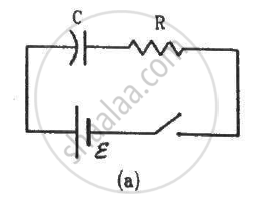
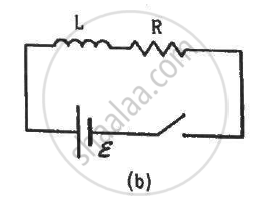
(a) The charge on C just after t = 0 is εC.
(b) The charge on C long after t = 0 is εC.
(c) The current in L just before t = t0 is ε/R.
(d) The current in L long after t = t0 is ε/R.
Fill in the blanks by writing (i) Only soft iron, (ii) Only steel, (iii) Both soft-iron and steel for the material of core and/or magnet.
Transformer______.
Name the following diagram and explain the concept behind it.
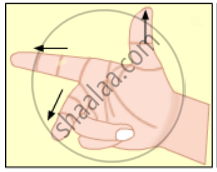
What is an electromagnet?
Why soft iron is preferred to be used as the core of the electromagnet of an electric bell?
Write Fleming’s right hand thumb rule with the help of diagram.
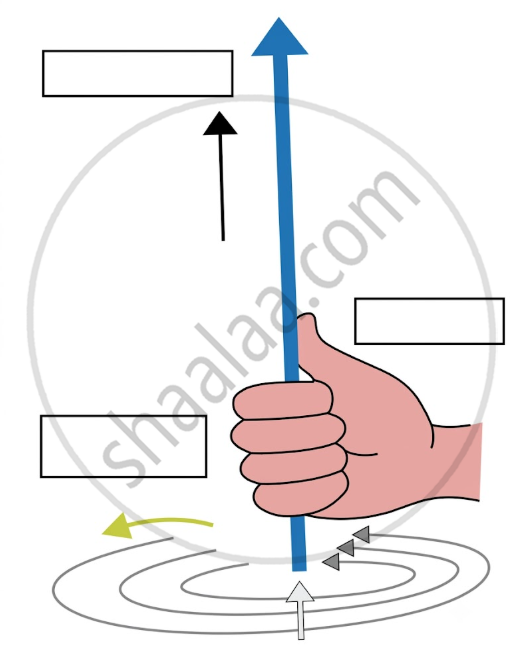
Write the two names in the following diagram.
Right hand thumb rule.
State Lenz’s law.
If the sun radiates energy at the rate of 3.6 × 1033 ergs/sec the rate at which the sun is loosing mass is given by ______.
What is produced when a magnet moves towards or away from a coil?
What is the current produced in a coil due to electromagnetic induction called?
