Advertisements
Advertisements
Question
Consider the energy density in a solenoid at its centre and that near its ends. Which of the two is greater?
Advertisements
Solution
In a solenoid, energy is stored in the form of a magnetic field. If a constant current flows through the solenoid, the magnetic field inside is approximately uniform at the centre but decreases near the ends. The energy per unit volume (or energy density) in the magnetic field is given by `mu = B^2/(2mu_0)`.
Since B is stronger at the centre and weaker near the ends, the energy density is greater at the centre than near the ends.
APPEARS IN
RELATED QUESTIONS
Electric field intensity in free space at a distance ‘r’ outside the charged conducting sphere of radius ‘R’ in terms of surface charge density ‘ a ’ is............................
(a)`sigma / in_0[R/r]^2`
(b)`in_0/sigma[R/r]^2`
(c)`R/r[sigma/in_0]^2`
(d)`R/sigma[r/in_0]^2`
When a bar magnet is pushed towards (or away) from the coil connected to a galvanometer, the pointer in the galvanometer deflects. Identify the phenomenon causing this deflection and write the factors on which the amount and direction of the deflection depends. State the laws describing this phenomenon.
Two circular coils A and B are placed closed to each other. If the current in the coil A is changed, will some current be induced in the coil B? Give reason.
If ‘R’ is the radius of dees and ‘B’ be the magnetic field of induction in which positive charges (q) of mass (m) escape from the cyclotron, then its maximum speed (vmax) is _______.
A) `(qR)/(Bm)`
B)`(qm)/(Br)`
C) `(qBR)/m`
D) `m/(qBR)`
How does an electromagnet differ forma permanent magnet?
Explain why, the core of an electromagnet should be of soft iron and not of steel.
What condition is necessary for the production of current by electromagnetic induction?
Name one device which works on the phenomenon of electromagnetic induction.
In which of the following case does the electromagnetic induction occur?
A loop of wire is held near a magnet.
Draw a simple labeled diagram of a step-up transformer.
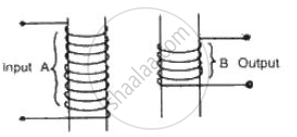
Complete the following diagram of a transformer and name the parts labeled A and B. Name the part you have drawn to complete the diagram . What is the material of this part? In this transformer a step-up or step-down? Why?
State Lenz’s law.
An induced current of 2.5 mA flows through a single conductor of resistance 100 Ω. Find out the rate at which the magnetic flux is cut by the conductor.
Shown in the figure below is a metre bridge set up with null deflection in the galvanometer. The value of the unknown resistance R is ______

A generator has an e.m.f. of 440 Volt and internal resistance of 4000 hm. Its terminals are connected to a load of 4000 ohm. The voltage across the load is ______.
Name some equipment that uses electromagnetism for functioning.
For making a strong electromagnet the material of the core should be ______.
The working of a dynamo is based on the principle of
Show that for a given positive ion species in a cyclotron, (i) the radius of their circular path inside a dee is directly proportional to their speed, and (ii) the maximum ion energy achievable is directly proportional to the square of the magnetic induction.
Which type of motor works on electromagnetic induction?
