Advertisements
Advertisements
Question
The following diagram shows a fixed coil of several turns connected to a center zero galvanometer G and a magnet NS which can move in the direction shown in the diagram.
- Describe the observation in the galvanometer if
- The magnet is moved rapidly,
- The magnet is kept still after it has moved into the coil
- The magnet is then rapidly pulled out the coil.
- How would the observation in (i) of part (a) change if a more powerful magnet is used?

Advertisements
Solution
-
- When the magnet is moved rapidly in the direction of arrow, the magnetic flux linked with the coil changes and there is a deflection in the galvanometer, indicating a flow of current through the coil.
- On keeping the magnet still, the magnetic flux linked with the coil does not change and there is no deflection in the galvanometer, indicating that no current is flowing through the coil.
- When the magnet is rapidly pulled out, there is again change in the magnetic flux linked with the coil and the galvanometer shows a deflection but this time in opposite direction, indicating that a current is flowing in opposite direction in the coil.
- If a more powerful magnet is used, deflection in the galvanometer will be large, indicating a greater amount of current.
APPEARS IN
RELATED QUESTIONS
List two ways of increasing the strength of an electromagnet if the material of the electromagnet is fixed.
Draw a labelled diagram to make an electromagnet from a soft iron bar. Mark the polarity at its ends in your diagram. What precaution would you observe while making it?
Find the odd one out and give its explanation.
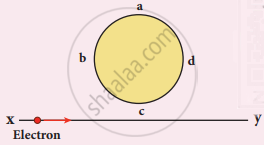
An electron moves on a straight-line path XY as shown in the figure. The coil abcd is adjacent to the path of the electron. What will be the direction of the current, if any, induced in the coil?
A square coil of side 30 cm with 500 turns is kept in a uniform magnetic field of 0.4 T. The plane of the coil is inclined at an angle of 30° to the field. Calculate the magnetic flux through the coil.
A coil of 200 turns carries a current of 4 A. If the magnetic flux through the coil is 6 x 10⁻⁵ Wb, find the magnetic energy stored in the medium surrounding the coil.
Shown in the figure below is a metre bridge set up with null deflection in the galvanometer. The value of the unknown resistance R is ______

Name some equipment that uses electromagnetism for functioning.
A galvanometer is an instrument that can detect the presence of a current in a circuit.
In the given circuit, initially switch S1 is closed and S2 and S3 are open. After charging of capacitor, at t = 0, S1 is open and S2 and S3 are closed. If the relation between inductance capacitance and resistance is L = 4CR2 then the time (in sec) after which current passing through capacitor and inductor will be same is ______ × 10-4 N. (Given R = ℓn(2)mΩ, L = 2mH)

