Advertisements
Advertisements
Question
The right-hand thumb rule is also called _______ rule.
Options
Newton’s law of motion
Newland’s law of Octave
Mendeleev’s periodic law
Maxwell’s cork- screw
Advertisements
Solution
The right-hand thumb rule is also called Maxwell’s cork- screw rule.
RELATED QUESTIONS
Electric field intensity in free space at a distance ‘r’ outside the charged conducting sphere of radius ‘R’ in terms of surface charge density ‘ a ’ is............................
(a)`sigma / in_0[R/r]^2`
(b)`in_0/sigma[R/r]^2`
(c)`R/r[sigma/in_0]^2`
(d)`R/sigma[r/in_0]^2`
A metal rod `1/sqrtpi `m long rotates about one of its ends perpendicular to a plane whose magnetic induction is 4 x 10⁻³ T. Calculate the number of revolutions made by the rod per second if the e.m.f. induced between the ends of the rod is 16 mV.
A rectangular wire loop of sides 8 cm and 2 cm with a small cut is moving out of a region of uniform magnetic field of magnitude 0.3 T directed normal to the loop. What is the emf developed across the cut if the velocity of the loop is 1 cm s−1 in a direction normal to the
- longer side,
- shorter side of the loop?
For how long does the induced voltage last in each case?
A horizontal straight wire 10 m long extending from east to west is falling with a speed of 5.0 m s−1, at right angles to the horizontal component of the earth’s magnetic field, 0.30 × 10⁻⁴ Wb m−2.
- What is the instantaneous value of the emf induced in the wire?
- What is the direction of the emf?
- Which end of the wire is at the higher electrical potential?
The magnetic flux through a loop is varying according to a relation `phi = 6t^2 + 7t + 1` where `phi` is in milliweber and t is in second. What is the e.m.f. induced in the loop at t = 2 second?
Name two devices in which electromagnets are used and two devices where permanent magnets are used.
Write some of the important uses of electromagnets.
Describe different ways to induce current in a coil of wire.
How is the working of an electric bell affected, if alternating current be used instead of direct current?
- What kind of energy change takes place when a magnet is moved towards a coil having a galvanometer at its ends?
- Name the phenomenon.
In which of the following case does the electromagnetic induction occur?
A magnet is moved through a loop of wire .
Name and state the law which determines the direction of induced current.
or
State Fleming’s right-hand rule.
When Puja, a student of 10th class, watched her mother washing clothes in the open, she observed coloured soap bubbles and was curious to know why the soap bubbles appear coloured. In the evening when her father, an engineer by profession, came home, she asked him this question. Her father explained to her the basic phenomenon of physics due to which the soap bubbles appear coloured.
(a) What according to you are the values displayed by Puja and her father?
(b) State the phenomenon of light involved in the formation of coloured soap bubbles.
Show diagrammatically how an alternating emf is generated by a loop of wire rotating in a magnetic field. Write the expression for the instantaneous value of the emf induced in the rotating loop.
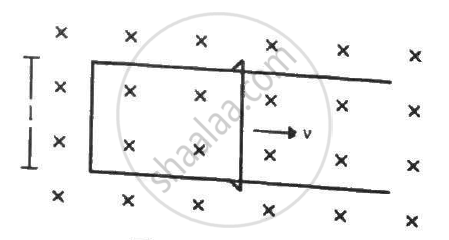
Figure shows a long U-shaped wire of width l placed in a perpendicular magnetic field B. A wire of length l is slid on the U-shaped wire with a constant velocity v towards right. The resistance of all the wires is r per unit length. At t = 0, the sliding wire is close to the left edge of the U-shaped wire. (a) Calculate the force needed to keep the sliding wire moving with a constant velocity v. (b) If the force needed just after t = 0 is F0, find the time at which the force needed will be F0/2.0
Can a transformer work when it is connected to a D.C. source? Give a reason.
Draw a simple labeled diagram of a step-up transformer.
Fill in the blanks by writing (i) Only soft iron, (ii) Only steel, (iii) Both soft-iron and steel for the material of core and/or magnet.
A. C. generator______.
Give an illustration of determining direction of induced current by using Lenz’s law.
The magnetic flux passing through a coil perpendicular to its plane is a function of time and is given by OB = (2t3 + 4t2 + 8t + 8) Wb. If the resistance of the coil is 5 Ω, determine the induced current through the coil at a time t = 3 second.
An induced current of 2.5 mA flows through a single conductor of resistance 100 Ω. Find out the rate at which the magnetic flux is cut by the conductor.
A 50 cm long solenoid has 400 turns per cm. The diameter of the solenoid is 0.04 m. Find the magnetic flux linked with each turn when it carries a current of 1 A.
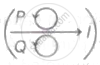
Metal rings P and Q are lying in the same plane, where current I is increasing steadily. The induced current in metal rings is shown correctly in figure.
What should be the core of an electromagnet?
Ansari Sir was demonstrating an experiment in his class with the setup as shown in the figure below.

A magnet is attached to a spring. The magnet can go in and out of the stationary coil. He lifted the Magnet and released it to make it oscillate through the coil.
Based on your understanding of the phenomenon, answer the following question.
What is the principle which Ansari Sir is trying to demonstrate?
Sea turtles return to their birth beach many decades after they were born due to ______.
A coil of one turn is made of a wire of certain length and then from the same length, a coil of two turns is made. If the same current is passed in both the cases, then the ratio of the magnetic inductions at their centres will be:
A 0.4 m wire, stretched horizontally, carries an electric current of 15 A, in a magnetic field whose magnetic field intensity is 0.1 N/Am. What is the magnitude of the wire?
A conductor of length 50 cm carrying a current of 5 A is placed perpendicular to a magnetic field of induction 2×10 -3T. Find the force on the conductor.
In the given circuit, initially switch S1 is closed and S2 and S3 are open. After charging of capacitor, at t = 0, S1 is open and S2 and S3 are closed. If the relation between inductance capacitance and resistance is L = 4CR2 then the time (in sec) after which current passing through capacitor and inductor will be same is ______ × 10-4 N. (Given R = ℓn(2)mΩ, L = 2mH)

The primary of a transformer has 400 turns while the secondary has 2000 turns. If the power output from the secondary at 1000 Vis 12 kW, what is the primary voltage?
What change can produce a current in a stationary conductor?
What happens when the current in a nearby solenoid coil is switched on or off?
Which device used for producing electricity works on electromagnetic induction?
Which group consists entirely of technologies that work on electromagnetic induction?
