Advertisements
Advertisements
Question
Give an illustration of determining direction of induced current by using Lenz’s law.
Advertisements
Solution
- Move the bar magnet towards the solenoid with north pole pointing solenoid.
- When the Magnetic flux increases in the coil, an induced current is produced, and the coil becomes a magnetic dipole.
- According to Lenz law, induced current opposes the movement of the north pole towards coil.
(a)
(b)
(c)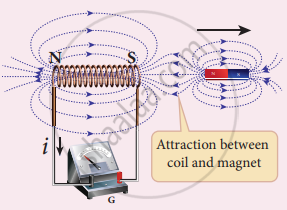
- It is possible if end nearer to magnet becomes the north pole, then it repels the north pole of the magnet and oppose the movement of the magnet.
- The direction of induced current is found by the right-hand thumb rule.
- When a bar magnet is withdrawn, the nearer end becomes south pole which attracts the north pole of the bar magnet, opposing the receding motion of the magnet.
7. Direction of induced current can be found from Lenz law.
APPEARS IN
RELATED QUESTIONS
Name and state the law which determines the direction of induced current.
or
State Fleming’s right-hand rule.
The switches in figure (a) and (b) are closed at t = 0 and reopened after a long time at t = t0.
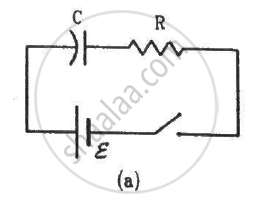
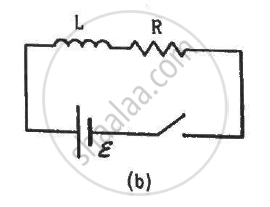
(a) The charge on C just after t = 0 is εC.
(b) The charge on C long after t = 0 is εC.
(c) The current in L just before t = t0 is ε/R.
(d) The current in L long after t = t0 is ε/R.
The diagram 10 shows two coils X and Y. The coil X is connected to a battery S and a key K. The coil Y is connected to a galvanometer G.
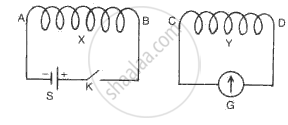
When the key K is closed. State the polarity
(i)At the end of the coil X,
(ii)At the end C of the coil Y,
(iii)At the end C of the coil Y if the coil Y is (a) Moved towards the coil X, (b) Moved away from the coil X.
Why soft iron is preferred to be used as the core of the electromagnet of an electric bell?
Choose the correct option:
A conductor rod of length (l) is moving with velocity (v) in a direction normal to a uniform magnetic field (B). What will be the magnitude of induced emf produced between the ends of the moving conductor?
Using Ampere's law, obtain an expression for the magnetic induction near a current-carrying straight infinitely long wire.
There is a uniform magnetic field directed perpendicular and into the plane of the paper. An irregular shaped conducting loop is slowly changing into a circular loop in the plane of the paper. Then ______.
AB is a coil of copper wire having a large number of turns. The ends of the coil are connected with a galvanometer as shown. When the north pole of a strong bar magnet is moved towards end B of the coil, a deflection is observed in the galvanometer.

- State the reason for using galvanometer in the activity and why does its needle deflects momentarily when magnet is moved towards the coil.
- What would be observed in the galvanometer in a situation when the coil and the bar magnet both move with the same speed in the same direction? Justify your answer.
- State the conclusion that can be drawn from this activity.
Will there be any change in the momentary deflection in the galvanometer if number of turns in the coil is increased and a more stronger magnet is moved towards the coil?
OR
What is electromagnetic induction? What is observed in the galvanometer when a strong bar magnet is held stationary near one end of a coil of large number of turns? Justify your answer.
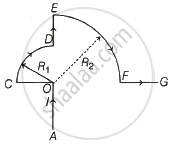
In the current carrying conductor (AOCDEFG) as shown, the magnetic induction at point O is ______.
(R1 and R2 are radii of CD and EF respectively. l = current in the loop, μ0 = permeability of free space)
What do moving electric charges produce?
