Advertisements
Advertisements
Question
Establish the fact that the relative motion between the coil and the magnet induces an emf in the coil of a closed circuit.
Advertisements
Solution
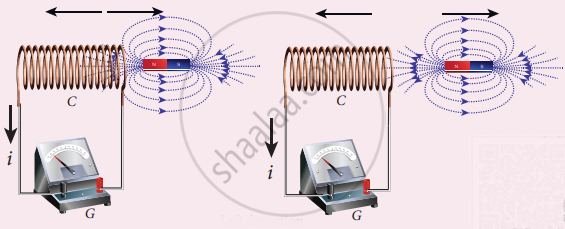
- In first experiment when bar magnet is placed close to the coil, magnetic lines pass through coil, the magnetic flux in coil increases and emf is induced hence electric current flows in the circuit.
- At the same time when they recede away from one another magnetic flux decreases emf is induced in opposite direction. Current flows in opposite direction. So there is a deflection in the galvanometer.
- In the second experiment, when the primary circuit is open, no electric current flows in it, magnetic flux linked with the secondary coil is zero.

(a) Right deflection - When primary circuit is closed, increasing current produces a magnetic field. So magnetic flux linked with coil increases. This induced current in the secondary coil.
(a) Left deflection - When the primary circuit is broken, decreasing primary current induces a current in the secondary coil but in opposite direction. So there is a deflection in Galvanorneter.
(a)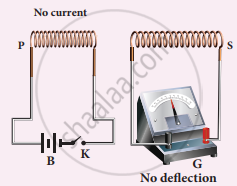
(b)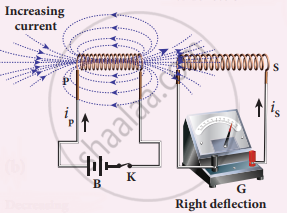
(c)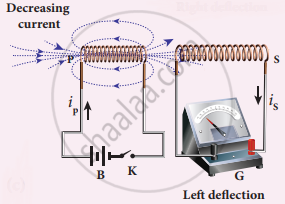
APPEARS IN
RELATED QUESTIONS
What is electromagnetic induction?
Name two devices in which electromagnets are used and two devices where permanent magnets are used.
Name and state the law which determines the direction of induced current.
or
State Fleming’s right-hand rule.
When Puja, a student of 10th class, watched her mother washing clothes in the open, she observed coloured soap bubbles and was curious to know why the soap bubbles appear coloured. In the evening when her father, an engineer by profession, came home, she asked him this question. Her father explained to her the basic phenomenon of physics due to which the soap bubbles appear coloured.
(a) What according to you are the values displayed by Puja and her father?
(b) State the phenomenon of light involved in the formation of coloured soap bubbles.
Can a transformer work when it is connected to a D.C. source? Give a reason.
The diagram 10 shows two coils X and Y. The coil X is connected to a battery S and a key K. The coil Y is connected to a galvanometer G.
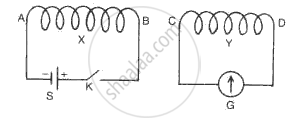
When the key K is closed. State the polarity
(i)At the end of the coil X,
(ii)At the end C of the coil Y,
(iii)At the end C of the coil Y if the coil Y is (a) Moved towards the coil X, (b) Moved away from the coil X.
Fig. shows a simple form of an A.C. generator.
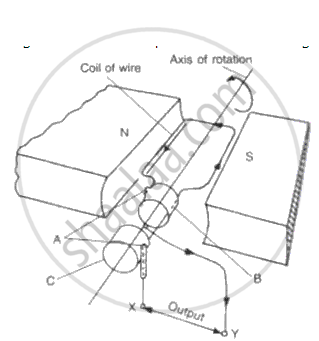
(a) Name the parts labeled A and B.
(b) What would be the effect of doubling the number of turns on the coil if the speed of rotation remains unchanged?
(c) Which of the output terminals is positive if the coil is rotating in the
direction shown in the diagram (anticlockwise)?
( d ) What is the position of the rotating coil when p.d. across its ends is zero? Explain why p.d. is zero when the coil is at this position .
(e) Sketch a graph showing how the p.d. across the ends of the rotating coil varies with time for an A.C. dynamo.
( f) On th e same sheet of paper and vertically below the first graph using the same time scale, sketch graphs to show the effect of
(i) Doubling the speed of rotation and at the same time keeping
the field and the number of turns constant,
(ii ) Doubling the number of turns on the coil and at the same time
doubling the speed of rotation of the coil, keeping th e speed
constant.
State Fleming’s Right Hand Rule.
The condition for the praenomen of electromagnetic induction is that there must be a relative motion between ____________.
What can produce a current in a coil even when the coil does not move?
