Advertisements
Advertisements
Question
Choose the correct option:
A conductor rod of length (l) is moving with velocity (v) in a direction normal to a uniform magnetic field (B). What will be the magnitude of induced emf produced between the ends of the moving conductor?
Options
BLv
BLv2
`1/2Blv`
`(2Bl)/v`
Advertisements
Solution
BLv
Explanation:
Step 1:
Let F = Force on charge q due to the motion of rod in the field
Therefore, `F = qVB` .....(1)
Where, q = charge on body (i.e. rod)
v = velocity of rod
B = Magnetic Field on the rod
Step 2:
This force on the charge is attributed to the induced electric field E
Therefore, `Eq = F` ......(2)
Substitute the values from (1) and (2) and calculate:
`E = V B` .....(3)
Therefore, an electric field `E = V B` is said to be induced in the rod due to the motion in the magnetic field.
Potential difference due to the field = emf induced (e) = Electric Field x Length
= `El`
Using (3),
e = `V Bl`
RELATED QUESTIONS
Electric field intensity in free space at a distance ‘r’ outside the charged conducting sphere of radius ‘R’ in terms of surface charge density ‘ a ’ is............................
(a)`sigma / in_0[R/r]^2`
(b)`in_0/sigma[R/r]^2`
(c)`R/r[sigma/in_0]^2`
(d)`R/sigma[r/in_0]^2`
The device used for producing electric current is called _________.
When a bar magnet is pushed towards (or away) from the coil connected to a galvanometer, the pointer in the galvanometer deflects. Identify the phenomenon causing this deflection and write the factors on which the amount and direction of the deflection depends. State the laws describing this phenomenon.
The phenomenon of electromagnetic induction is
What is electromagnetic induction?
Prove theoretically (electromagnetic induction) `e = (dphi)/(dt)`
A circular coil of cross-sectional area 200 cm2 and 20 turns is rotated about the vertical diameter with angular speed of 50 rad s−1 in a uniform magnetic field of magnitude 3.0 × 10⁻²T. Calculate the maximum value of the current in the coil.
Name a common device that uses electromagnets.
When an electric current is passed through any wire, a magnetic field is produced around it. Then why an electric iron connecting cable does not attract nearby iron objects when electric current switched on through it?
State the factors on which the strength of an electromagnet depends. How does it depend on these factors?
The most suitable material for making the core of an electromagnet is:
(a) soft iron
(b) brass
(c) aluminium
(d) steel
Name one device which works on the phenomenon of electromagnetic induction.
An induced current is produced when a magnet is moved into a coil. The magnitude of induced current does not depend on:
(a) the speed with which the magnet is moved
(b) the number of turns of the coil
(c) the resistivity of the wire of the coil
(d) the strength of the magnet
When the magnet shown in the diagram below is moving towards the coil, the galvanometer gives a reading to the right.
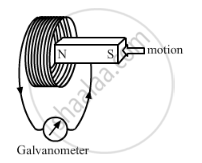
() What is the name of the effect being produced by the moving magnet?
(2) State what happens to the reading shown on the galvanometer when the magnet is moving away from the coil.
(3) The original experiment is repeated. This time the magnet is moved towards the coil at a great speed. State two changes you would notice in the reading on the galvanometer.
Name and state the law which determines the direction of induced current.
or
State Fleming’s right-hand rule.
Welders wear special goggles or face masks with glass windows to protect their eyes from electromagnetic radiations. Name the radiations and write the range of their frequency.
Electromagnetic induction means ______.
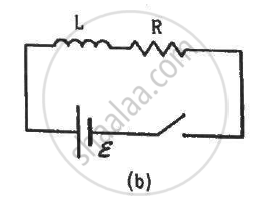
The switches in figure (a) and (b) are closed at t = 0 and reopened after a long time at t = t0.
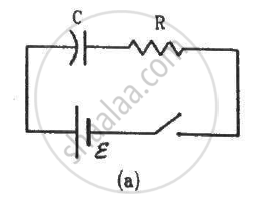
(a) The charge on C just after t = 0 is εC.
(b) The charge on C long after t = 0 is εC.
(c) The current in L just before t = t0 is ε/R.
(d) The current in L long after t = t0 is ε/R.
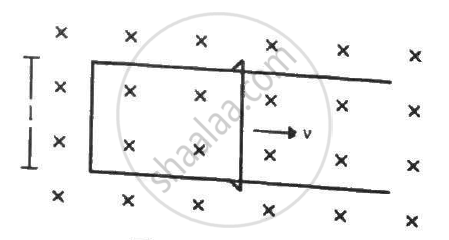
Figure shows a long U-shaped wire of width l placed in a perpendicular magnetic field B. A wire of length l is slid on the U-shaped wire with a constant velocity v towards right. The resistance of all the wires is r per unit length. At t = 0, the sliding wire is close to the left edge of the U-shaped wire. (a) Calculate the force needed to keep the sliding wire moving with a constant velocity v. (b) If the force needed just after t = 0 is F0, find the time at which the force needed will be F0/2.0
Can a transformer work when it is connected to a D.C. source? Give a reason.
Draw and label the diagram of a simple D.C. motor.
(a) Explain the rotation of the coil, giving a reason for your answer.
(b) How can you reverse the direction of rotation of the armature?
(c) How can you increase the speed of rotation of the motor?
Fill in the blanks by writing (i) Only soft iron, (ii) Only steel, (iii) Both soft-iron and steel for the material of core and/or magnet.
A. C. generator______.
State Fleming’s Right Hand Rule.
Answer the following:
State the principles of the electric motor and electric generator.
Draw a labelled diagram to show how an electromagnet is made.
List two ways of increasing the strength of an electromagnet if the material of the electromagnet is fixed.
You have been provided with a solenoid AB.
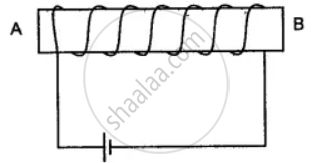
(i) What is the polarity at end A?
(ii) Give one advantage of an electromagnet over a permanent magnet.
Observe the given figure of Fleming’s Right Hand Rule and write the labels of A and B correctly.
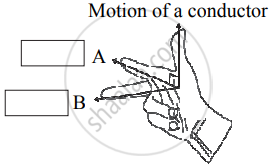
A thin semi-circular conducting ring (PQR) of radius r is falling with its plane vertical in a horizontal magnetic field B, as shown in the figure.
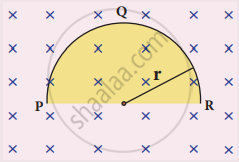
The potential difference developed across the ring when its speed v , is
What for an inductor is used? Give some examples.
Obtain an expression for motional emf from Lorentz force.
A straight metal wire crosses a magnetic field of flux 4 mWb in a time 0.4 s. Find the magnitude of the emf induced in the wire.
An induced current of 2.5 mA flows through a single conductor of resistance 100 Ω. Find out the rate at which the magnetic flux is cut by the conductor.
Metal rings P and Q are lying in the same plane, where current I is increasing steadily. The induced current in metal rings is shown correctly in figure.
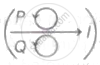
A layer of atmosphere that reflects medium frequency radio waves which is ineffective during night, is ______.
A metal plate can be heated by ______.
Ansari Sir was demonstrating an experiment in his class with the setup as shown in the figure below.

A magnet is attached to a spring. The magnet can go in and out of the stationary coil. He lifted the Magnet and released it to make it oscillate through the coil.
Based on your understanding of the phenomenon, answer the following question.
Consider the situation where the Magnet goes in and out of the coil. State two changes which could be made to increase the deflection in the galvanometer.
If the sun radiates energy at the rate of 3.6 × 1033 ergs/sec the rate at which the sun is loosing mass is given by ______.
In the given circuit, initially switch S1 is closed and S2 and S3 are open. After charging of capacitor, at t = 0, S1 is open and S2 and S3 are closed. If the relation between inductance capacitance and resistance is L = 4CR2 then the time (in sec) after which current passing through capacitor and inductor will be same is ______ × 10-4 N. (Given R = ℓn(2)mΩ, L = 2mH)

Which scientists established in the early nineteenth century that electricity and magnetism are related?
What do moving electric charges produce?
Around 1830, who showed that an electric current can be induced in a closed coil exposed to a changing magnetic field?
What can produce a current in a coil even when the coil does not move?
Which movement of a coil can produce a current?
What is produced when a magnet moves towards or away from a coil?
What is the current produced in a coil due to electromagnetic induction called?
What is a changing magnetic field?
Which device used for producing electricity works on electromagnetic induction?
