Advertisements
Advertisements
Questions
Write Fleming’s right hand thumb rule with the help of diagram.
Write Fleming’s right-hand thumb rule.
Explain the right-hand thumb rule with the help of a diagram.
Advertisements
Solution
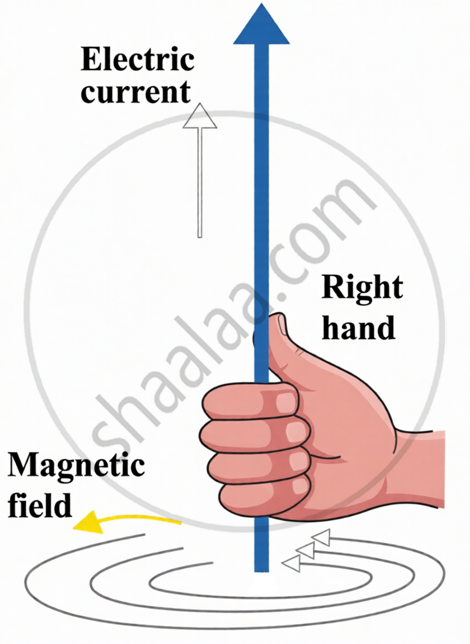
If a current-carrying straight conductor is held in our right hand such that the thumb points towards the direction of the current, then the curled fingers around the conductor will give the direction of the magnetic field.
APPEARS IN
RELATED QUESTIONS
Explain different ways to induce current in a coil.
The phenomenon of electromagnetic induction is
Two circular coils A and B are placed closed to each other. If the current in the coil A is changed, will some current be induced in the coil B? Give reason.
It is desired to measure the magnitude of field between the poles of a powerful loud speaker magnet. A small flat search coil of area 2 cm2 with 25 closely wound turns, is positioned normal to the field direction, and then quickly snatched out of the field region. Equivalently, one can give it a quick 90° turn to bring its plane parallel to the field direction. The total charge flown in the coil (measured by a ballistic galvanometer connected to coil) is 7.5 mC. The combined resistance of the coil and the galvanometer is 0.50 Ω. Estimate the field strength of magnet.
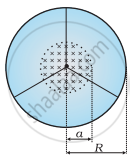
A line charge λ per unit length is lodged uniformly onto the rim of a wheel of mass M and radius R. The wheel has light non-conducting spokes and is free to rotate without friction about its axis (Figure). A uniform magnetic field extends over a circular region within the rim. It is given by,
B = − B0 k (r ≤ a; a < R)
= 0 (otherwise)
What is the angular velocity of the wheel after the field is suddenly switched off?
The magnetic flux through a loop is varying according to a relation `phi = 6t^2 + 7t + 1` where `phi` is in milliweber and t is in second. What is the e.m.f. induced in the loop at t = 2 second?
Name a common device that uses electromagnets.
What is an electromagnet? Describe the construction and working of an electromagnet with the help of a labelled diagram.
Explain why, the core of an electromagnet should be of soft iron and not of steel.
Write some of the important uses of electromagnets.
The most suitable material for making the core of an electromagnet is:
(a) soft iron
(b) brass
(c) aluminium
(d) steel
State whether the following statement are true or false:
A motor works on the principle electric generator?
What do you understand by the term "electromagnetic induction"? Explain with the help of a diagram.
When the magnet shown in the diagram below is moving towards the coil, the galvanometer gives a reading to the right.
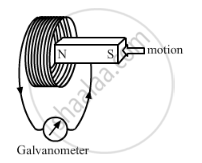
() What is the name of the effect being produced by the moving magnet?
(2) State what happens to the reading shown on the galvanometer when the magnet is moving away from the coil.
(3) The original experiment is repeated. This time the magnet is moved towards the coil at a great speed. State two changes you would notice in the reading on the galvanometer.
- What kind of energy change takes place when a magnet is moved towards a coil having a galvanometer at its ends?
- Name the phenomenon.
Welders wear special glass goggles while working. Why? Explain.
Fill in the blanks by writing (i) Only soft iron, (ii) Only steel, (iii) Both soft-iron and steel for the material of core and/or magnet.
A. C. generator______.
Fill in the blanks by writing (i) Only soft iron, (ii) Only steel, (iii) Both soft-iron and steel for the material of core and/or magnet.
Transformer______.
List some of the practical applications of an electromagnet.
Find the odd one out and give its explanation.
Obtain an expression for motional emf from Lorentz force.
A square coil of side 30 cm with 500 turns is kept in a uniform magnetic field of 0.4 T. The plane of the coil is inclined at an angle of 30° to the field. Calculate the magnetic flux through the coil.
The magnetic flux passing through a coil perpendicular to its plane is a function of time and is given by OB = (2t3 + 4t2 + 8t + 8) Wb. If the resistance of the coil is 5 Ω, determine the induced current through the coil at a time t = 3 second.
A generator has an e.m.f. of 440 Volt and internal resistance of 4000 hm. Its terminals are connected to a load of 4000 ohm. The voltage across the load is ______.
The instrument that use to defect electric current in the circuit is known as ____________.
What should be the core of an electromagnet?
Induced current flows through a coil ______.
A galvanometer is an instrument that can detect the presence of a current in a circuit.
A 0.4 m wire, stretched horizontally, carries an electric current of 15 A, in a magnetic field whose magnetic field intensity is 0.1 N/Am. What is the magnitude of the wire?
Show that for a given positive ion species in a cyclotron, (i) the radius of their circular path inside a dee is directly proportional to their speed, and (ii) the maximum ion energy achievable is directly proportional to the square of the magnetic induction.
What do moving electric charges produce?
What can produce a current in a coil even when the coil does not move?
Which change in the current of a nearby solenoid coil can produce an induced current?
What is a coil?
Which type of motor works on electromagnetic induction?
