Advertisements
Advertisements
प्रश्न
Write Fleming’s right hand thumb rule with the help of diagram.
Write Fleming’s right-hand thumb rule.
Explain the right-hand thumb rule with the help of a diagram.
Advertisements
उत्तर
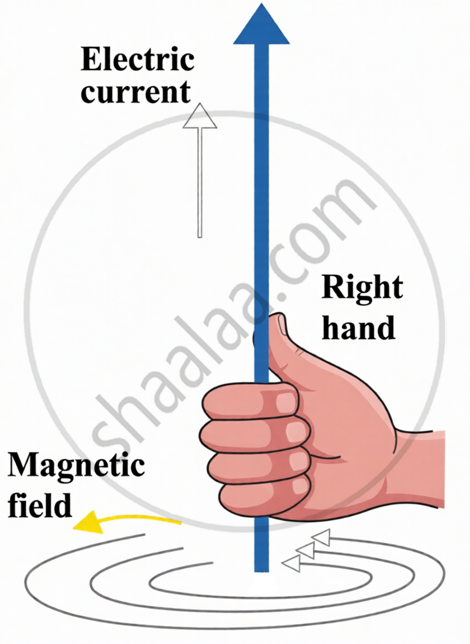
If a current-carrying straight conductor is held in our right hand such that the thumb points towards the direction of the current, then the curled fingers around the conductor will give the direction of the magnetic field.
APPEARS IN
संबंधित प्रश्न
State three differences between direct current and alternating current.
When a bar magnet is pushed towards (or away) from the coil connected to a galvanometer, the pointer in the galvanometer deflects. Identify the phenomenon causing this deflection and write the factors on which the amount and direction of the deflection depends. State the laws describing this phenomenon.
Name a common device that uses electromagnets.
An emf of 2V is induced in a coil when the current in it is changed from 0A to 10A in 0·40 sec. Find the coefficient of self-inductance of the coil.
State three ways in which the strength of an electromagnet can be increased.
State the factors on which the strength of an electromagnet depends. How does it depend on these factors?
When current is 'switched on' and 'switched off' in a coil, a current is induced in another coil kept near it. What is this phenomenon known as?
Describe different ways to induce current in a coil of wire.
Show diagrammatically how an alternating emf is generated by a loop of wire rotating in a magnetic field. Write the expression for the instantaneous value of the emf induced in the rotating loop.
L, C and R represent the physical quantities inductance, capacitance and resistance respectively. Which of the following combinations have dimensions of frequency?
(a) `1/(RC)`
(b) `R/L`
(c) `1/sqrt(LC)`
(d) C/L
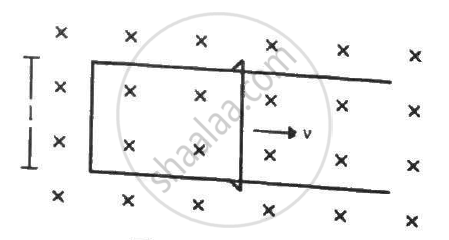
Figure shows a long U-shaped wire of width l placed in a perpendicular magnetic field B. A wire of length l is slid on the U-shaped wire with a constant velocity v towards right. The resistance of all the wires is r per unit length. At t = 0, the sliding wire is close to the left edge of the U-shaped wire. (a) Calculate the force needed to keep the sliding wire moving with a constant velocity v. (b) If the force needed just after t = 0 is F0, find the time at which the force needed will be F0/2.0
Fill in the blanks by writing (i) Only soft iron, (ii) Only steel, (iii) Both soft-iron and steel for the material of core and/or magnet.
Transformer______.
A coil has a self-inductance of 0·05 Henry. Find the magnitude of the emf induced in it when the current flowing through it is changing at the rate of 100 As-1.
Choose the correct option:
A conductor rod of length (l) is moving with velocity (v) in a direction normal to a uniform magnetic field (B). What will be the magnitude of induced emf produced between the ends of the moving conductor?
The energy stored in a 50 mH inductor carrying a current of 4 A is ______
Fleming's left hand rule : electric current : : Fleming's right hand rule : _______
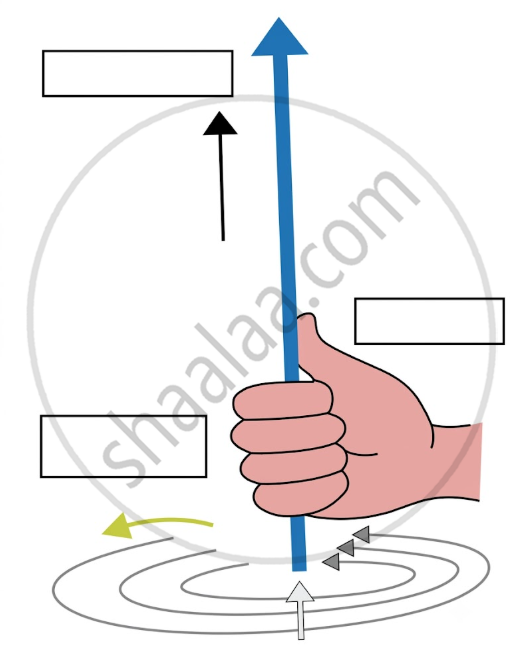
Write the two names in the following diagram.
Right hand thumb rule.
A closely wound circular coil of radius 0.02 m is placed perpendicular to the magnetic field. When the magnetic field is changed from 8000 T to 2000 T in 6 s, an emf of 44 V is induced in it. Calculate the number of turns in the coil.
A metal plate can be heated by ______.
Ansari Sir was demonstrating an experiment in his class with the setup as shown in the figure below.

A magnet is attached to a spring. The magnet can go in and out of the stationary coil. He lifted the Magnet and released it to make it oscillate through the coil.
Based on your understanding of the phenomenon, answer the following question.
What is the principle which Ansari Sir is trying to demonstrate?
Ansari Sir was demonstrating an experiment in his class with the setup as shown in the figure below.
A magnet is attached to a spring. The magnet can go in and out of the stationary coil. He lifted the Magnet and released it to make it oscillate through the coil.
Based on your understanding of the phenomenon, answer the following question.
Consider the situation where the Magnet goes in and out of the coil. State two changes which could be made to increase the deflection in the galvanometer.
Name some equipment that uses electromagnetism for functioning.
Which of the following instruments works by electromagnetic induction?
A conductor of length 50 cm carrying a current of 5 A is placed perpendicular to a magnetic field of induction 2×10 -3T. Find the force on the conductor.
A rectangular, a square, a circular and an elliptical loop, all in the (x - y) plane, are moving out of a uniform magnetic field with a constant velocity `vecv = vhati`. The magnetic field is directed along the negative z-axis direction. The induced emf, during the passage of these loops, out of the field region, will not remain constant for ______.
A current I = 10 sin(100π t) A is passed in first coil, which induces a maximum e.m.f of 5π volt in second coil. The mutual inductance between the coils is ______.
A sheet is placed on horizontal surface in front of a strong magnetic pole. A force is needed to:
- hold the sheet there if it is magnetic.
- hold the sheet there if it is non-magnetic.
- move the sheet away from the pole with uniform velocity if it is conducting.
- move the sheet away from the pole with uniform velocity if it is both, non-conducting and nonpolar.
Choose the correct statement(s) from the options given below:
Which scientists established in the early nineteenth century that electricity and magnetism are related?
What happens when the current in a nearby solenoid coil is switched on or off?
Which change in the current of a nearby solenoid coil can produce an induced current?
Which movement can change the number of magnetic field lines passing through a coil near a solenoid?
What is a coil?
Which type of motor works on electromagnetic induction?
