Advertisements
Advertisements
प्रश्न
When a bar magnet is pushed towards (or away) from the coil connected to a galvanometer, the pointer in the galvanometer deflects. Identify the phenomenon causing this deflection and write the factors on which the amount and direction of the deflection depends. State the laws describing this phenomenon.
Advertisements
उत्तर
When a bar magnet is pushed towards (or away) from the coil connected to a galvanometer, the pointer in the galvanometer deflects because of the phenomenon of electromagnetic induction.
Factors on which the amount and direction of deflection depend are
(i) Speed of the magnet
(ii) Polarity of the magnet
Laws describing electromagnetic induction are
(1) Faraday’s law of electromagnetic induction: The magnitude of the induced emf in a circuit is equal to the time rate of change of magnetic flux through the circuit.
`epsilon=-(dphi)/dt`
(2) Lenz’s law: The polarity of induced emf is such that it tends to produce a current which opposes the change in magnetic flux that produced it.
APPEARS IN
संबंधित प्रश्न
A rectangular wire loop of sides 8 cm and 2 cm with a small cut is moving out of a region of uniform magnetic field of magnitude 0.3 T directed normal to the loop. What is the emf developed across the cut if the velocity of the loop is 1 cm s−1 in a direction normal to the
- longer side,
- shorter side of the loop?
For how long does the induced voltage last in each case?
What is electromagnetic induction?
When an electric current is passed through any wire, a magnetic field is produced around it. Then why an electric iron connecting cable does not attract nearby iron objects when electric current switched on through it?
Name two devices in which electromagnets are used and two devices where permanent magnets are used.
How is the working of an electric bell affected, if alternating current be used instead of direct current?
A conducting square loop having edges of length 2.0 cm is rotated through 180° about a diagonal in 0.20 s. A magnetic field B exists in the region which is perpendicular to the loop in its initial position. If the average induced emf during the rotation is 20 mV, find the magnitude of the magnetic field.
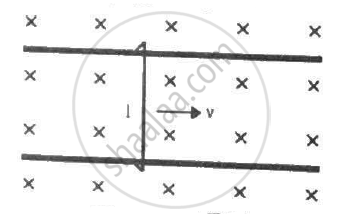
Figure shows a wire sliding on two parallel, conducting rails placed at a separation l. A magnetic field B exists in a direction perpendicular to the plane of the rails. What force is necessary to keep the wire moving at a constant velocity v?
Draw and label the diagram of a simple D.C. motor.
(a) Explain the rotation of the coil, giving a reason for your answer.
(b) How can you reverse the direction of rotation of the armature?
(c) How can you increase the speed of rotation of the motor?
Draw a labelled diagram to make an electromagnet from a soft iron bar. Mark the polarity at its ends in your diagram. What precaution would you observe while making it?
You have been provided with a solenoid AB.
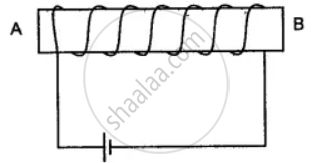
(i) What is the polarity at end A?
(ii) Give one advantage of an electromagnet over a permanent magnet.
