Advertisements
Advertisements
प्रश्न
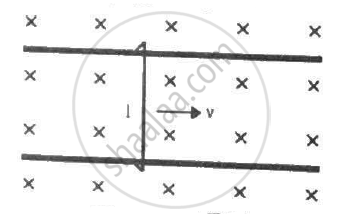
Figure shows a wire sliding on two parallel, conducting rails placed at a separation l. A magnetic field B exists in a direction perpendicular to the plane of the rails. What force is necessary to keep the wire moving at a constant velocity v?
Advertisements
उत्तर
Because the force exerted by the magnetic field on the rod is given by Fmagnetic = ilB, the direction of this force is opposite to that of the motion of the rod.
Now, let the external force on it be F.
Because the velocity is constant, the net force acting on the wire must be zero.
APPEARS IN
संबंधित प्रश्न
Explain different ways to induce current in a coil.
The phenomenon of electromagnetic induction is
State whether the following statement are true or false:
A generator works on the principle of electromagnetic induction.
In which of the following case does the electromagnetic induction occur?
A loop of wire is held near a magnet.
Welders wear special goggles or face masks with glass windows to protect their eyes from electromagnetic radiations. Name the radiations and write the range of their frequency.
A conducting rod is moved with a constant velocity v in a magnetic field. A potential difference appears across the two ends _____________ .
Can a transformer work when it is connected to a D.C. source? Give a reason.
List some of the practical applications of an electromagnet.
What is an electromagnet? What do you know about the simplest form of an electromagnet?
The energy stored in a 50 mH inductor carrying a current of 4 A is ______
Fleming's left hand rule : electric current : : Fleming's right hand rule : _______
Write the two names in the following diagram.
Fleming’s right hand rule.
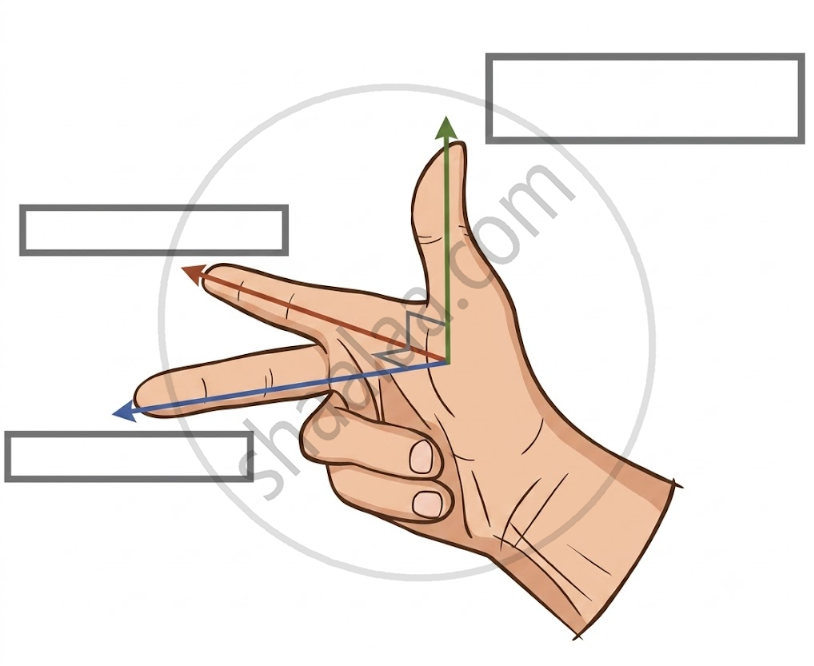
State Fleming’s right-hand rule.
Shown in the figure below is a metre bridge set up with null deflection in the galvanometer. The value of the unknown resistance R is ______

Ansari Sir was demonstrating an experiment in his class with the setup as shown in the figure below.

A magnet is attached to a spring. The magnet can go in and out of the stationary coil. He lifted the Magnet and released it to make it oscillate through the coil.
Based on your understanding of the phenomenon, answer the following question.
What will be observed when the Magnet starts oscillating through the coil. Explain the reason behind this observation.
If the sun radiates energy at the rate of 3.6 × 1033 ergs/sec the rate at which the sun is loosing mass is given by ______.
Which movement of a coil can produce a current?
What happens when the current in a nearby solenoid coil is switched on or off?
Which device used for using electricity developed from Faraday’s and Henry’s experiments?
Which group consists entirely of technologies that work on electromagnetic induction?
