Advertisements
Advertisements
प्रश्न
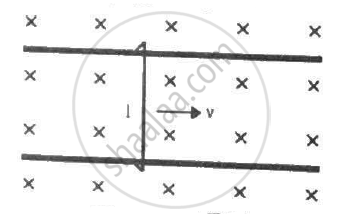
Figure shows a wire sliding on two parallel, conducting rails placed at a separation l. A magnetic field B exists in a direction perpendicular to the plane of the rails. What force is necessary to keep the wire moving at a constant velocity v?
Advertisements
उत्तर
Because the force exerted by the magnetic field on the rod is given by Fmagnetic = ilB, the direction of this force is opposite to that of the motion of the rod.
Now, let the external force on it be F.
Because the velocity is constant, the net force acting on the wire must be zero.
APPEARS IN
संबंधित प्रश्न
A solenoid of length 1.5 m and 4 cm in diameter possesses 10 turns per metre. A current of 5 A is flowing through it. The magnetic induction at a point inside the solenoid along the axis is ............................. .
(μ0 = 4π × 10-7 Wb/Am)
- π × 10-5 T
- 2π × 10-5 T
- 3π × 10-5 T
- 4π × 10-5 T
If ‘R’ is the radius of dees and ‘B’ be the magnetic field of induction in which positive charges (q) of mass (m) escape from the cyclotron, then its maximum speed (vmax) is _______.
A) `(qR)/(Bm)`
B)`(qm)/(Br)`
C) `(qBR)/m`
D) `m/(qBR)`
Name a common device that uses electromagnets.
State the factors on which the strength of an electromagnet depends. How does it depend on these factors?
The north-south polarities of an electromagnet can be found easily by using:
(a) Fleming's right-hand rule
(b) Fleming's left-hand rule
(c) Clock face rule
(d) Left-hand thumb rule
Electromagnetic induction means ______.
Calculate the dimensions of (a) \[\int \overrightarrow{E} . d \overrightarrow{l,}\] (b) vBl and (c) \[\frac{d \Phi_B}{dt}.\] The symbols have their usual meaning.
Choose the correct option:
A conductor rod of length (l) is moving with velocity (v) in a direction normal to a uniform magnetic field (B). What will be the magnitude of induced emf produced between the ends of the moving conductor?
The energy stored in a 50 mH inductor carrying a current of 4 A is ______
Using Ampere's law, obtain an expression for the magnetic induction near a current-carrying straight infinitely long wire.
The magnetic flux passing through a coil perpendicular to its plane is a function of time and is given by OB = (2t3 + 4t2 + 8t + 8) Wb. If the resistance of the coil is 5 Ω, determine the induced current through the coil at a time t = 3 second.
A closely wound circular coil of radius 0.02 m is placed perpendicular to the magnetic field. When the magnetic field is changed from 8000 T to 2000 T in 6 s, an emf of 44 V is induced in it. Calculate the number of turns in the coil.
Shown in the figure below is a metre bridge set up with null deflection in the galvanometer. The value of the unknown resistance R is ______

Ansari Sir was demonstrating an experiment in his class with the setup as shown in the figure below.

A magnet is attached to a spring. The magnet can go in and out of the stationary coil. He lifted the Magnet and released it to make it oscillate through the coil.
Based on your understanding of the phenomenon, answer the following question.
What will be observed when the Magnet starts oscillating through the coil. Explain the reason behind this observation.
For making a strong electromagnet the material of the core should be ______.
AB is a coil of copper wire having a large number of turns. The ends of the coil are connected with a galvanometer as shown. When the north pole of a strong bar magnet is moved towards end B of the coil, a deflection is observed in the galvanometer.

- State the reason for using galvanometer in the activity and why does its needle deflects momentarily when magnet is moved towards the coil.
- What would be observed in the galvanometer in a situation when the coil and the bar magnet both move with the same speed in the same direction? Justify your answer.
- State the conclusion that can be drawn from this activity.
Will there be any change in the momentary deflection in the galvanometer if number of turns in the coil is increased and a more stronger magnet is moved towards the coil?
OR
What is electromagnetic induction? What is observed in the galvanometer when a strong bar magnet is held stationary near one end of a coil of large number of turns? Justify your answer.
How were electricity and magnetism considered for a long time?
Around 1830, who showed that an electric current can be induced in a closed coil exposed to a changing magnetic field?
Which movement can change the number of magnetic field lines passing through a coil near a solenoid?
