Advertisements
Advertisements
Question
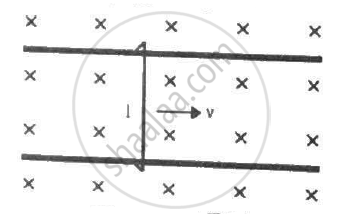
Figure shows a wire sliding on two parallel, conducting rails placed at a separation l. A magnetic field B exists in a direction perpendicular to the plane of the rails. What force is necessary to keep the wire moving at a constant velocity v?
Advertisements
Solution
Because the force exerted by the magnetic field on the rod is given by Fmagnetic = ilB, the direction of this force is opposite to that of the motion of the rod.
Now, let the external force on it be F.
Because the velocity is constant, the net force acting on the wire must be zero.
APPEARS IN
RELATED QUESTIONS
State the factors on which the strength of an electromagnet depends. How does it depend on these factors?
Name one device which works on the phenomenon of electromagnetic induction.
Describe one experiment to demonstrate the phenomenon of electromagnetic induction.
In which of the following case does the electromagnetic induction occur?
A magnet is moved through a loop of wire .
The coil of a moving-coil galvanometer keeps on oscillating for a long time if it is deflected and released. If the ends of the coil are connected together, the oscillation stops at once. Explain.
A conducting square loop having edges of length 2.0 cm is rotated through 180° about a diagonal in 0.20 s. A magnetic field B exists in the region which is perpendicular to the loop in its initial position. If the average induced emf during the rotation is 20 mV, find the magnitude of the magnetic field.
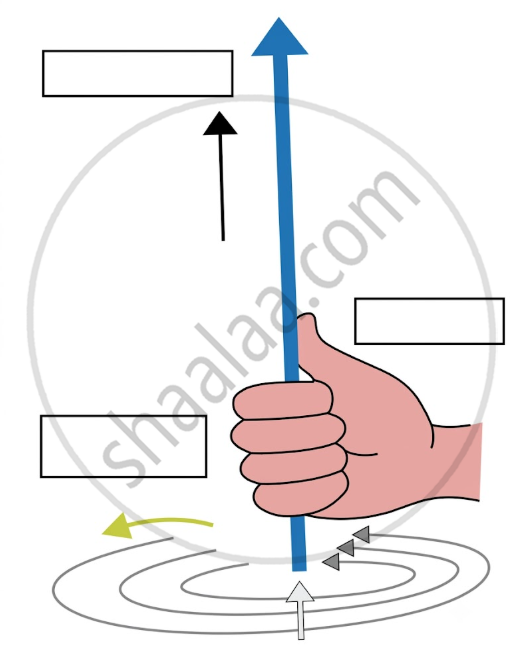
Write the two names in the following diagram.
Right hand thumb rule.
A thin semi-circular conducting ring (PQR) of radius r is falling with its plane vertical in a horizontal magnetic field B, as shown in the figure.
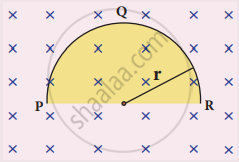
The potential difference developed across the ring when its speed v , is
State Lenz’s law.
What for an inductor is used? Give some examples.
A square coil of side 30 cm with 500 turns is kept in a uniform magnetic field of 0.4 T. The plane of the coil is inclined at an angle of 30° to the field. Calculate the magnetic flux through the coil.
Shown in the figure below is a metre bridge set up with null deflection in the galvanometer. The value of the unknown resistance R is ______

The instrument that use to defect electric current in the circuit is known as ____________.
If the sun radiates energy at the rate of 3.6 × 1033 ergs/sec the rate at which the sun is loosing mass is given by ______.
The working of a dynamo is based on the principle of
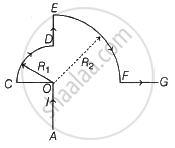
In the current carrying conductor (AOCDEFG) as shown, the magnetic induction at point O is ______.
(R1 and R2 are radii of CD and EF respectively. l = current in the loop, μ0 = permeability of free space)
Which type of force is experienced by a moving charge in a magnetic field?
How were electricity and magnetism considered for a long time?
Which device used for using electricity developed from Faraday’s and Henry’s experiments?
