Advertisements
Advertisements
प्रश्न
Fill in the blanks by writing (i) Only soft iron, (ii) Only steel, (iii) Both soft-iron and steel for the material of core and/or magnet.
D.C. motor ______.
Advertisements
उत्तर
D.C. motor core- soft iron, magnet - steel
APPEARS IN
संबंधित प्रश्न
When a bar magnet is pushed towards (or away) from the coil connected to a galvanometer, the pointer in the galvanometer deflects. Identify the phenomenon causing this deflection and write the factors on which the amount and direction of the deflection depends. State the laws describing this phenomenon.
It is desired to measure the magnitude of field between the poles of a powerful loud speaker magnet. A small flat search coil of area 2 cm2 with 25 closely wound turns, is positioned normal to the field direction, and then quickly snatched out of the field region. Equivalently, one can give it a quick 90° turn to bring its plane parallel to the field direction. The total charge flown in the coil (measured by a ballistic galvanometer connected to coil) is 7.5 mC. The combined resistance of the coil and the galvanometer is 0.50 Ω. Estimate the field strength of magnet.
Draw a simple labeled diagram of a step-up transformer.
You have been provided with a solenoid AB.
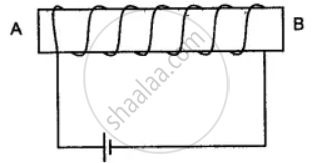
(i) What is the polarity at end A?
(ii) Give one advantage of an electromagnet over a permanent magnet.
We can induce the current in a coil by ____________.
A rectangular, a square, a circular and an elliptical loop, all in the (x - y) plane, are moving out of a uniform magnetic field with a constant velocity `vecv = vhati`. The magnetic field is directed along the negative z-axis direction. The induced emf, during the passage of these loops, out of the field region, will not remain constant for ______.
AB is a coil of copper wire having a large number of turns. The ends of the coil are connected with a galvanometer as shown. When the north pole of a strong bar magnet is moved towards end B of the coil, a deflection is observed in the galvanometer.

- State the reason for using galvanometer in the activity and why does its needle deflects momentarily when magnet is moved towards the coil.
- What would be observed in the galvanometer in a situation when the coil and the bar magnet both move with the same speed in the same direction? Justify your answer.
- State the conclusion that can be drawn from this activity.
Will there be any change in the momentary deflection in the galvanometer if number of turns in the coil is increased and a more stronger magnet is moved towards the coil?
OR
What is electromagnetic induction? What is observed in the galvanometer when a strong bar magnet is held stationary near one end of a coil of large number of turns? Justify your answer.
What did Faraday show in 1831?
What is produced when a magnet moves towards or away from a coil?
Which type of motor works on electromagnetic induction?
