Advertisements
Advertisements
प्रश्न
The diagram shows a rectangular coil ABCD, suspended freely between the concave pole pieces of a permanent horseshoe magnet, such that the plane of the coil is parallel to the magnetic field.
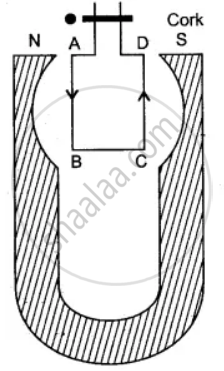
- State your observation when the current is switched on.
- Give an explanation for your observation in (i).
- State the rule, which will help you to find the motion of rotation of the coil.
- In which position will the coil ultimately come to rest?
- State four ways of increasing the magnitude of force acting on the coil.
Advertisements
उत्तर
- The coil ABCD will turn. The arm AB of the coil will move out of the plane of the paper and arm CD into the plane of the paper. Thus, the coil will turn in the anticlockwise direction.
- A magnetic field is set up by the coil due to the passage of electric current. The magnetic field of the coil is at right angles to the magnetic field of the permanent magnet. Thus, a magnetic couple acts, which turns the coil.
- Fleming’s left rule: It states: Stretch the thumb, the forefinger, and the middle finger of the left hand such that the forefinger points in the direction of the magnetic field and the middle finger points in the direction of the current. Then, the thumb points in the direction of motion of the conductor.
- The coil will come to rest at right angles to the direction of the magnetic field.
-
- By increasing the number of turns in the coil.
- By increasing the area of the cross-section of the coil.
- By placing a laminated soft iron core within the coil.
- By increasing the magnitude of the current coil.
संबंधित प्रश्न
What is an electromagnet? Describe the construction and working of an electromagnet with the help of a labelled diagram.
An induced current is produced when a magnet is moved into a coil. The magnitude of induced current does not depend on:
(a) the speed with which the magnet is moved
(b) the number of turns of the coil
(c) the resistivity of the wire of the coil
(d) the strength of the magnet
Describe one experiment to demonstrate the phenomenon of electromagnetic induction.
Welders wear special goggles or face masks with glass windows to protect their eyes from electromagnetic radiations. Name the radiations and write the range of their frequency.
Consider the energy density in a solenoid at its centre and that near its ends. Which of the two is greater?
The diagram 10 shows two coils X and Y. The coil X is connected to a battery S and a key K. The coil Y is connected to a galvanometer G.
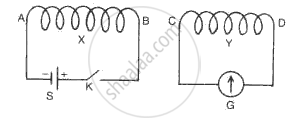
When the key K is closed. State the polarity
(i)At the end of the coil X,
(ii)At the end C of the coil Y,
(iii)At the end C of the coil Y if the coil Y is (a) Moved towards the coil X, (b) Moved away from the coil X.
What is an electromagnet? What do you know about the simplest form of an electromagnet?
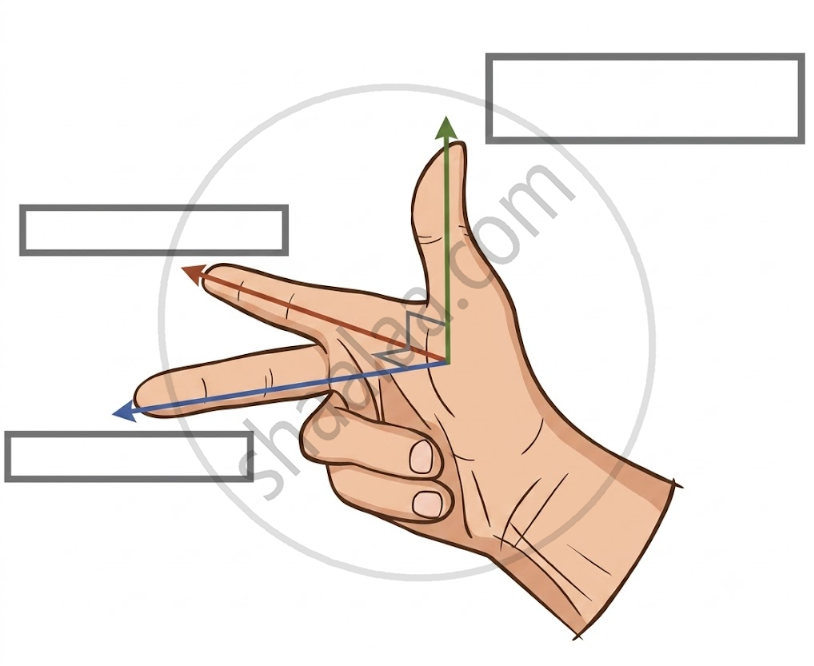
Write the two names in the following diagram.
Fleming’s right hand rule.
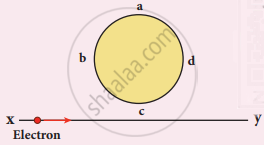
An electron moves on a straight-line path XY as shown in the figure. The coil abcd is adjacent to the path of the electron. What will be the direction of the current, if any, induced in the coil?
One solenoid is centered inside another. The outer one has a length of 50.0 cm and contains 6750 coils, while the coaxial inner solenoid is 3.0 cm long and π cm2 in area and contains 150 coils. The current in the outer solenoid is changing at 3000 A/s. The emf induced in the inner solenoid is ______ V.
(Round off to two decimal places.)
