Advertisements
Advertisements
प्रश्न
The diagram shows a rectangular coil ABCD, suspended freely between the concave pole pieces of a permanent horseshoe magnet, such that the plane of the coil is parallel to the magnetic field.
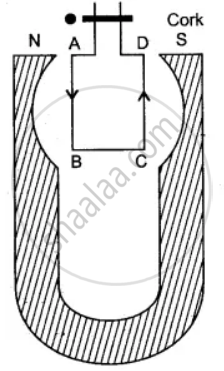
- State your observation when the current is switched on.
- Give an explanation for your observation in (i).
- State the rule, which will help you to find the motion of rotation of the coil.
- In which position will the coil ultimately come to rest?
- State four ways of increasing the magnitude of force acting on the coil.
Advertisements
उत्तर
- The coil ABCD will turn. The arm AB of the coil will move out of the plane of the paper and arm CD into the plane of the paper. Thus, the coil will turn in the anticlockwise direction.
- A magnetic field is set up by the coil due to the passage of electric current. The magnetic field of the coil is at right angles to the magnetic field of the permanent magnet. Thus, a magnetic couple acts, which turns the coil.
- Fleming’s left rule: It states: Stretch the thumb, the forefinger, and the middle finger of the left hand such that the forefinger points in the direction of the magnetic field and the middle finger points in the direction of the current. Then, the thumb points in the direction of motion of the conductor.
- The coil will come to rest at right angles to the direction of the magnetic field.
-
- By increasing the number of turns in the coil.
- By increasing the area of the cross-section of the coil.
- By placing a laminated soft iron core within the coil.
- By increasing the magnitude of the current coil.
संबंधित प्रश्न
The device used for producing electric current is called _________.
A metal rod `1/sqrtpi `m long rotates about one of its ends perpendicular to a plane whose magnetic induction is 4 x 10⁻³ T. Calculate the number of revolutions made by the rod per second if the e.m.f. induced between the ends of the rod is 16 mV.
A horizontal straight wire 10 m long extending from east to west is falling with a speed of 5.0 m s−1, at right angles to the horizontal component of the earth’s magnetic field, 0.30 × 10⁻⁴ Wb m−2.
- What is the instantaneous value of the emf induced in the wire?
- What is the direction of the emf?
- Which end of the wire is at the higher electrical potential?
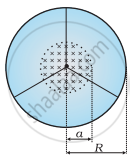
A line charge λ per unit length is lodged uniformly onto the rim of a wheel of mass M and radius R. The wheel has light non-conducting spokes and is free to rotate without friction about its axis (Figure). A uniform magnetic field extends over a circular region within the rim. It is given by,
B = − B0 k (r ≤ a; a < R)
= 0 (otherwise)
What is the angular velocity of the wheel after the field is suddenly switched off?
What is an electromagnet? Describe the construction and working of an electromagnet with the help of a labelled diagram.
Describe different ways to induce current in a coil of wire.
A conducting square loop having edges of length 2.0 cm is rotated through 180° about a diagonal in 0.20 s. A magnetic field B exists in the region which is perpendicular to the loop in its initial position. If the average induced emf during the rotation is 20 mV, find the magnitude of the magnetic field.
Draw and label the diagram of a simple D.C. motor.
(a) Explain the rotation of the coil, giving a reason for your answer.
(b) How can you reverse the direction of rotation of the armature?
(c) How can you increase the speed of rotation of the motor?
Why soft iron is preferred to be used as the core of the electromagnet of an electric bell?
What did Faraday show in 1831?
