Advertisements
Advertisements
Question
The diagram shows a rectangular coil ABCD, suspended freely between the concave pole pieces of a permanent horseshoe magnet, such that the plane of the coil is parallel to the magnetic field.
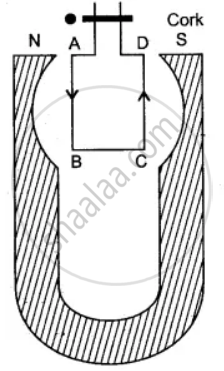
- State your observation when the current is switched on.
- Give an explanation for your observation in (i).
- State the rule, which will help you to find the motion of rotation of the coil.
- In which position will the coil ultimately come to rest?
- State four ways of increasing the magnitude of force acting on the coil.
Advertisements
Solution
- The coil ABCD will turn. The arm AB of the coil will move out of the plane of the paper and arm CD into the plane of the paper. Thus, the coil will turn in the anticlockwise direction.
- A magnetic field is set up by the coil due to the passage of electric current. The magnetic field of the coil is at right angles to the magnetic field of the permanent magnet. Thus, a magnetic couple acts, which turns the coil.
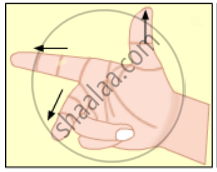
- Fleming’s left rule: It states: Stretch the thumb, the forefinger, and the middle finger of the left hand such that the forefinger points in the direction of the magnetic field and the middle finger points in the direction of the current. Then, the thumb points in the direction of motion of the conductor.
- The coil will come to rest at right angles to the direction of the magnetic field.
-
- By increasing the number of turns in the coil.
- By increasing the area of the cross-section of the coil.
- By placing a laminated soft iron core within the coil.
- By increasing the magnitude of the current coil.
RELATED QUESTIONS
A solenoid of length 1.5 m and 4 cm in diameter possesses 10 turns per metre. A current of 5 A is flowing through it. The magnetic induction at a point inside the solenoid along the axis is ............................. .
(μ0 = 4π × 10-7 Wb/Am)
- π × 10-5 T
- 2π × 10-5 T
- 3π × 10-5 T
- 4π × 10-5 T
Explain different ways to induce current in a coil.
A horizontal straight wire 10 m long extending from east to west is falling with a speed of 5.0 m s−1, at right angles to the horizontal component of the earth’s magnetic field, 0.30 × 10⁻⁴ Wb m−2.
- What is the instantaneous value of the emf induced in the wire?
- What is the direction of the emf?
- Which end of the wire is at the higher electrical potential?
It is desired to measure the magnitude of field between the poles of a powerful loud speaker magnet. A small flat search coil of area 2 cm2 with 25 closely wound turns, is positioned normal to the field direction, and then quickly snatched out of the field region. Equivalently, one can give it a quick 90° turn to bring its plane parallel to the field direction. The total charge flown in the coil (measured by a ballistic galvanometer connected to coil) is 7.5 mC. The combined resistance of the coil and the galvanometer is 0.50 Ω. Estimate the field strength of magnet.
State the factors on which the strength of an electromagnet depends. How does it depend on these factors?
Name the following diagram and explain the concept behind it.
A coil of 200 turns carries a current of 4 A. If the magnetic flux through the coil is 6 x 10⁻⁵ Wb, find the magnetic energy stored in the medium surrounding the coil.
A cylindrical bar magnet (A) and similar unmagnetized cylindrical iron bar (B) are dropped through metallic pipe. The time taken to come down by ____________.
AB is a coil of copper wire having a large number of turns. The ends of the coil are connected with a galvanometer as shown. When the north pole of a strong bar magnet is moved towards end B of the coil, a deflection is observed in the galvanometer.

- State the reason for using galvanometer in the activity and why does its needle deflects momentarily when magnet is moved towards the coil.
- What would be observed in the galvanometer in a situation when the coil and the bar magnet both move with the same speed in the same direction? Justify your answer.
- State the conclusion that can be drawn from this activity.
Will there be any change in the momentary deflection in the galvanometer if number of turns in the coil is increased and a more stronger magnet is moved towards the coil?
OR
What is electromagnetic induction? What is observed in the galvanometer when a strong bar magnet is held stationary near one end of a coil of large number of turns? Justify your answer.
A current I = 10 sin(100π t) A is passed in first coil, which induces a maximum e.m.f of 5π volt in second coil. The mutual inductance between the coils is ______.
