Advertisements
Advertisements
Question
State three differences between direct current and alternating current.
Advertisements
Solution
| Direct current | Alternating current | ||
| 1 | Direct current flows only in one direction. | 1 | Alternating current reverses its direction periodically with time. |
| 2 | It cannot be used in large-scale generation of electricity for household purposes. | 2 | It is used in household electrical appliances such as electric heater, electric iron, refrigerator etc. |
| 3 | The frequency of direct current is zero. | 3 | The frequency of alternating current in India is 50 Hz. |
APPEARS IN
RELATED QUESTIONS
The magnetic flux through a loop varies according to the relation Φ = 8t2 + 6t + C, where ‘C’ is constant, 'Φ' is in milliweber and 't' is in second. What is the magnitude of induced e.m.f. in the loop at t = 2 seconds.
State Fleming’s right-hand rule.
Name a common device that uses electromagnets.
An emf of 2V is induced in a coil when the current in it is changed from 0A to 10A in 0·40 sec. Find the coefficient of self-inductance of the coil.
Name two devices in which electromagnets are used and two devices where permanent magnets are used.
Explain why, the core of an electromagnet should be of soft iron and not of steel.
State the factors on which the strength of an electromagnet depends. How does it depend on these factors?
State whether the following statement are true or false:
A motor works on the principle electric generator?
Name one device which works on the phenomenon of electromagnetic induction.
Describe different ways to induce current in a coil of wire.
How is the working of an electric bell affected, if alternating current be used instead of direct current?
Describe one experiment to demonstrate the phenomenon of electromagnetic induction.
When Puja, a student of 10th class, watched her mother washing clothes in the open, she observed coloured soap bubbles and was curious to know why the soap bubbles appear coloured. In the evening when her father, an engineer by profession, came home, she asked him this question. Her father explained to her the basic phenomenon of physics due to which the soap bubbles appear coloured.
(a) What according to you are the values displayed by Puja and her father?
(b) State the phenomenon of light involved in the formation of coloured soap bubbles.
Consider the energy density in a solenoid at its centre and that near its ends. Which of the two is greater?
The switches in figure (a) and (b) are closed at t = 0 and reopened after a long time at t = t0.
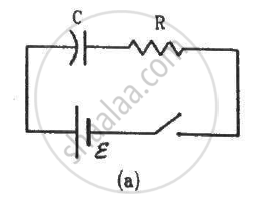
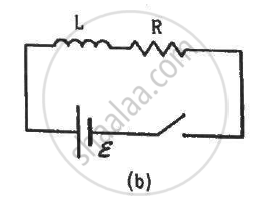
(a) The charge on C just after t = 0 is εC.
(b) The charge on C long after t = 0 is εC.
(c) The current in L just before t = t0 is ε/R.
(d) The current in L long after t = t0 is ε/R.
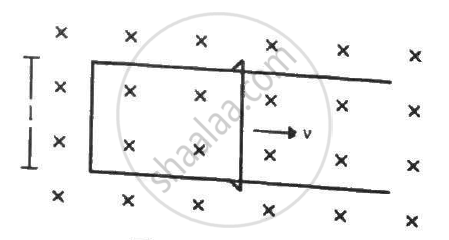
Figure shows a long U-shaped wire of width l placed in a perpendicular magnetic field B. A wire of length l is slid on the U-shaped wire with a constant velocity v towards right. The resistance of all the wires is r per unit length. At t = 0, the sliding wire is close to the left edge of the U-shaped wire. (a) Calculate the force needed to keep the sliding wire moving with a constant velocity v. (b) If the force needed just after t = 0 is F0, find the time at which the force needed will be F0/2.0
Can a transformer work when it is connected to a D.C. source? Give a reason.
What is an electromagnet? What do you know about the simplest form of an electromagnet?
Choose the correct option:
A conductor rod of length (l) is moving with velocity (v) in a direction normal to a uniform magnetic field (B). What will be the magnitude of induced emf produced between the ends of the moving conductor?
Which of the following scientist invented the rule of electromagnetic induction?
Fleming's left hand rule : electric current : : Fleming's right hand rule : _______
Write Fleming’s right hand thumb rule with the help of diagram.
What for an inductor is used? Give some examples.
Show that Lenz’s law is in accordance with the law of conservation of energy.
A cylindrical bar magnet (A) and similar unmagnetized cylindrical iron bar (B) are dropped through metallic pipe. The time taken to come down by ____________.
There is a uniform magnetic field directed perpendicular and into the plane of the paper. An irregular shaped conducting loop is slowly changing into a circular loop in the plane of the paper. Then ______.
The condition for the praenomen of electromagnetic induction is that there must be a relative motion between ____________.
For making a strong electromagnet the material of the core should be ______.
A 0.4 m wire, stretched horizontally, carries an electric current of 15 A, in a magnetic field whose magnetic field intensity is 0.1 N/Am. What is the magnitude of the wire?
The working of a dynamo is based on the principle of
In the given circuit, initially switch S1 is closed and S2 and S3 are open. After charging of capacitor, at t = 0, S1 is open and S2 and S3 are closed. If the relation between inductance capacitance and resistance is L = 4CR2 then the time (in sec) after which current passing through capacitor and inductor will be same is ______ × 10-4 N. (Given R = ℓn(2)mΩ, L = 2mH)

A sheet is placed on horizontal surface in front of a strong magnetic pole. A force is needed to:
- hold the sheet there if it is magnetic.
- hold the sheet there if it is non-magnetic.
- move the sheet away from the pole with uniform velocity if it is conducting.
- move the sheet away from the pole with uniform velocity if it is both, non-conducting and nonpolar.
Choose the correct statement(s) from the options given below:
How were electricity and magnetism considered for a long time?
Which scientists established in the early nineteenth century that electricity and magnetism are related?
What happens when the current in a nearby solenoid coil is switched on or off?
Which change in the current of a nearby solenoid coil can produce an induced current?
Which device used for producing electricity works on electromagnetic induction?
Which type of motor works on electromagnetic induction?
