Advertisements
Advertisements
प्रश्न
State three differences between direct current and alternating current.
Advertisements
उत्तर
| Direct current | Alternating current | ||
| 1 | Direct current flows only in one direction. | 1 | Alternating current reverses its direction periodically with time. |
| 2 | It cannot be used in large-scale generation of electricity for household purposes. | 2 | It is used in household electrical appliances such as electric heater, electric iron, refrigerator etc. |
| 3 | The frequency of direct current is zero. | 3 | The frequency of alternating current in India is 50 Hz. |
APPEARS IN
संबंधित प्रश्न
The magnetic flux through a loop varies according to the relation Φ = 8t2 + 6t + C, where ‘C’ is constant, 'Φ' is in milliweber and 't' is in second. What is the magnitude of induced e.m.f. in the loop at t = 2 seconds.
The device used for producing electric current is called _________.
Explain different ways to induce current in a coil.
Two circular coils A and B are placed closed to each other. If the current in the coil A is changed, will some current be induced in the coil B? Give reason.
A rectangular wire loop of sides 8 cm and 2 cm with a small cut is moving out of a region of uniform magnetic field of magnitude 0.3 T directed normal to the loop. What is the emf developed across the cut if the velocity of the loop is 1 cm s−1 in a direction normal to the
- longer side,
- shorter side of the loop?
For how long does the induced voltage last in each case?
It is desired to measure the magnitude of field between the poles of a powerful loud speaker magnet. A small flat search coil of area 2 cm2 with 25 closely wound turns, is positioned normal to the field direction, and then quickly snatched out of the field region. Equivalently, one can give it a quick 90° turn to bring its plane parallel to the field direction. The total charge flown in the coil (measured by a ballistic galvanometer connected to coil) is 7.5 mC. The combined resistance of the coil and the galvanometer is 0.50 Ω. Estimate the field strength of magnet.
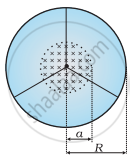
A line charge λ per unit length is lodged uniformly onto the rim of a wheel of mass M and radius R. The wheel has light non-conducting spokes and is free to rotate without friction about its axis (Figure). A uniform magnetic field extends over a circular region within the rim. It is given by,
B = − B0 k (r ≤ a; a < R)
= 0 (otherwise)
What is the angular velocity of the wheel after the field is suddenly switched off?
What is electromagnetic induction?
State three ways in which the strength of an electromagnet can be increased.
Name two devices in which electromagnets are used and two devices where permanent magnets are used.
Write some of the important uses of electromagnets.
The direction of current in the coil at one end of an electromagnet is clockwise. This end of the electromagnet will be:
(a) north pole
(b) east pole
(c) south pole
(d) west pole
What do you understand by the term "electromagnetic induction"? Explain with the help of a diagram.
Name one device which works on the phenomenon of electromagnetic induction.
Welders wear special goggles or face masks with glass windows to protect their eyes from electromagnetic radiations. Name the radiations and write the range of their frequency.
Show diagrammatically how an alternating emf is generated by a loop of wire rotating in a magnetic field. Write the expression for the instantaneous value of the emf induced in the rotating loop.
Electromagnetic induction means ______.
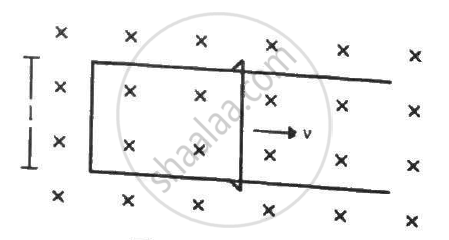
Figure shows a long U-shaped wire of width l placed in a perpendicular magnetic field B. A wire of length l is slid on the U-shaped wire with a constant velocity v towards right. The resistance of all the wires is r per unit length. At t = 0, the sliding wire is close to the left edge of the U-shaped wire. (a) Calculate the force needed to keep the sliding wire moving with a constant velocity v. (b) If the force needed just after t = 0 is F0, find the time at which the force needed will be F0/2.0
The diagram 10 shows two coils X and Y. The coil X is connected to a battery S and a key K. The coil Y is connected to a galvanometer G.
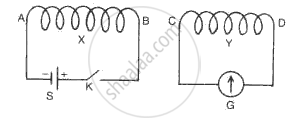
When the key K is closed. State the polarity
(i)At the end of the coil X,
(ii)At the end C of the coil Y,
(iii)At the end C of the coil Y if the coil Y is (a) Moved towards the coil X, (b) Moved away from the coil X.
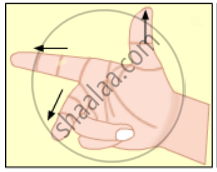
Name the following diagram and explain the concept behind it.
Draw a labelled diagram to make an electromagnet from a soft iron bar. Mark the polarity at its ends in your diagram. What precaution would you observe while making it?
State the condition at which we say the two coils kept close to each other are perfectly coupled with each other.
Find the odd one out and give its explanation.
Establish the fact that the relative motion between the coil and the magnet induces an emf in the coil of a closed circuit.
We can induce the current in a coil by ____________.
Ansari Sir was demonstrating an experiment in his class with the setup as shown in the figure below.

A magnet is attached to a spring. The magnet can go in and out of the stationary coil. He lifted the Magnet and released it to make it oscillate through the coil.
Based on your understanding of the phenomenon, answer the following question.
What is the principle which Ansari Sir is trying to demonstrate?
If the sun radiates energy at the rate of 3.6 × 1033 ergs/sec the rate at which the sun is loosing mass is given by ______.
The working of a dynamo is based on the principle of
One solenoid is centered inside another. The outer one has a length of 50.0 cm and contains 6750 coils, while the coaxial inner solenoid is 3.0 cm long and π cm2 in area and contains 150 coils. The current in the outer solenoid is changing at 3000 A/s. The emf induced in the inner solenoid is ______ V.
(Round off to two decimal places.)
The charge will flow through a galvanometer of resistance 200Ω connected to a 400Ω circular coil of 1000 turns wound on a wooden stick 20 mm in diameter, if a magnetic field B = 0.012 T parallel to the axis of the stick decreased suddenly to zero, is near ______.
When an electric current is passed through a wire or a coil, a magnetic field is produced. Is the reverse phenomenon possible i.e, can a magnetic field produce an electric current? Explain with the help of an appropriate example.
Which movement can change the number of magnetic field lines passing through a coil near a solenoid?
What is a coil?
Which type of motor works on electromagnetic induction?
