Advertisements
Advertisements
प्रश्न
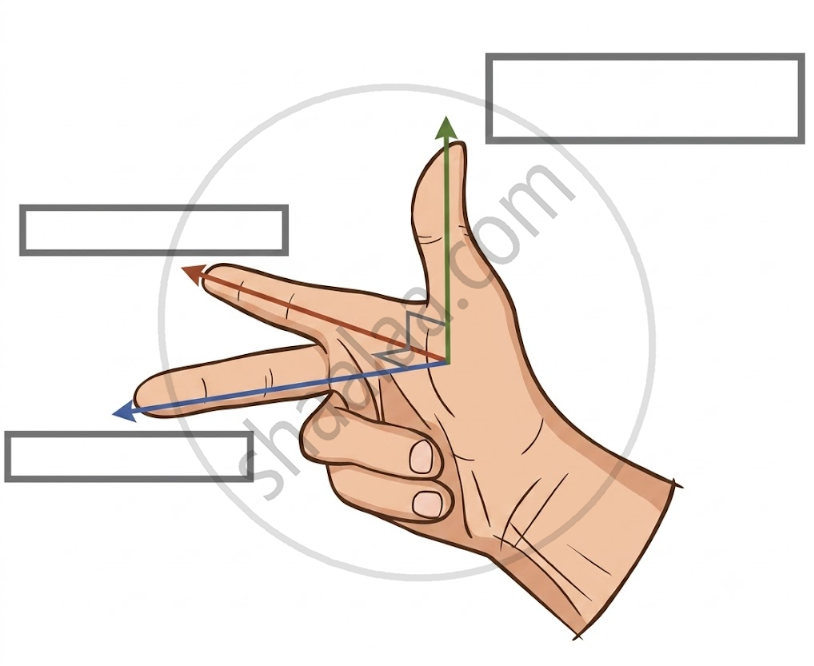
Write Fleming’s right hand thumb rule with the help of diagram.
Write Fleming’s right-hand thumb rule.
Explain the right-hand thumb rule with the help of a diagram.
Advertisements
उत्तर
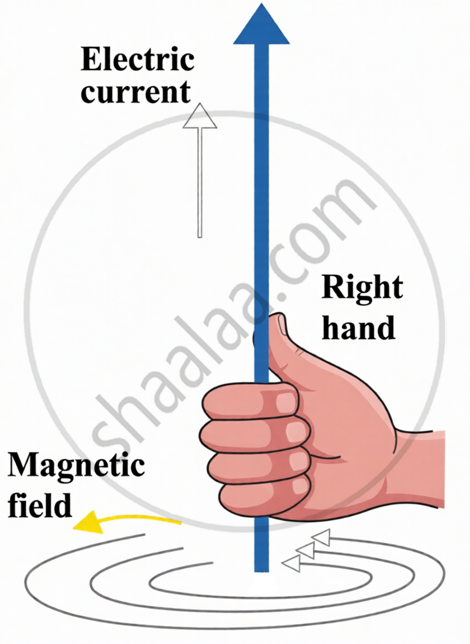
If a current-carrying straight conductor is held in our right hand such that the thumb points towards the direction of the current, then the curled fingers around the conductor will give the direction of the magnetic field.
APPEARS IN
संबंधित प्रश्न
The device used for producing electric current is called _________.
State three differences between direct current and alternating current.
A metal rod `1/sqrtpi `m long rotates about one of its ends perpendicular to a plane whose magnetic induction is 4 x 10⁻³ T. Calculate the number of revolutions made by the rod per second if the e.m.f. induced between the ends of the rod is 16 mV.
A horizontal straight wire 10 m long extending from east to west is falling with a speed of 5.0 m s−1, at right angles to the horizontal component of the earth’s magnetic field, 0.30 × 10⁻⁴ Wb m−2.
- What is the instantaneous value of the emf induced in the wire?
- What is the direction of the emf?
- Which end of the wire is at the higher electrical potential?
A circular coil of cross-sectional area 200 cm2 and 20 turns is rotated about the vertical diameter with angular speed of 50 rad s−1 in a uniform magnetic field of magnitude 3.0 × 10⁻²T. Calculate the maximum value of the current in the coil.
Explain why, the core of an electromagnet should be of soft iron and not of steel.
The north-south polarities of an electromagnet can be found easily by using:
(a) Fleming's right-hand rule
(b) Fleming's left-hand rule
(c) Clock face rule
(d) Left-hand thumb rule
The direction of current in the coil at one end of an electromagnet is clockwise. This end of the electromagnet will be:
(a) north pole
(b) east pole
(c) south pole
(d) west pole
In which of the following case does the electromagnetic induction occur?
A loop of wire is held near a magnet.
Welders wear special glass goggles while working. Why? Explain.
A conducting square loop of side l and resistance R moves in its plane with a uniform velocity v perpendicular to one of its sides. A uniform and constant magnetic field Bexists along the perpendicular to the plane of the loop as shown in figure. The current induced in the loop is _____________ .
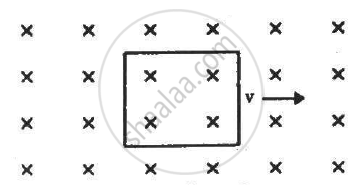
A conducting rod is moved with a constant velocity v in a magnetic field. A potential difference appears across the two ends _____________ .
Draw a simple labeled diagram of a step-down transformer.
The following diagram shows a fixed coil of several turns connected to a center zero galvanometer G and a magnet NS which can move in the direction shown in the diagram.
- Describe the observation in the galvanometer if
- The magnet is moved rapidly,
- The magnet is kept still after it has moved into the coil
- The magnet is then rapidly pulled out the coil.
- How would the observation in (i) of part (a) change if a more powerful magnet is used?

Fig. shows a simple form of an A.C. generator.
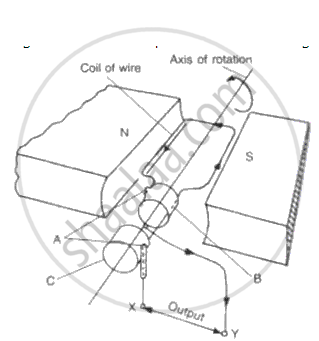
(a) Name the parts labeled A and B.
(b) What would be the effect of doubling the number of turns on the coil if the speed of rotation remains unchanged?
(c) Which of the output terminals is positive if the coil is rotating in the
direction shown in the diagram (anticlockwise)?
( d ) What is the position of the rotating coil when p.d. across its ends is zero? Explain why p.d. is zero when the coil is at this position .
(e) Sketch a graph showing how the p.d. across the ends of the rotating coil varies with time for an A.C. dynamo.
( f) On th e same sheet of paper and vertically below the first graph using the same time scale, sketch graphs to show the effect of
(i) Doubling the speed of rotation and at the same time keeping
the field and the number of turns constant,
(ii ) Doubling the number of turns on the coil and at the same time
doubling the speed of rotation of the coil, keeping th e speed
constant.
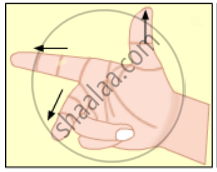
Name the following diagram and explain the concept behind it.
What is an electromagnet?
Using Ampere's law, obtain an expression for the magnetic induction near a current-carrying straight infinitely long wire.
Which of the following scientist invented the rule of electromagnetic induction?
Find the odd one out and give its explanation.
Write the two names in the following diagram.
Fleming’s right hand rule.
State Lenz’s law.
Establish the fact that the relative motion between the coil and the magnet induces an emf in the coil of a closed circuit.
A coil of 200 turns carries a current of 4 A. If the magnetic flux through the coil is 6 x 10⁻⁵ Wb, find the magnetic energy stored in the medium surrounding the coil.
Shown in the figure below is a metre bridge set up with null deflection in the galvanometer. The value of the unknown resistance R is ______

A metal plate can be heated by ______.
The condition for the praenomen of electromagnetic induction is that there must be a relative motion between ____________.
The instrument that use to defect electric current in the circuit is known as ____________.
If the sun radiates energy at the rate of 3.6 × 1033 ergs/sec the rate at which the sun is loosing mass is given by ______.
For making a strong electromagnet the material of the core should be ______.
A conductor of length 50 cm carrying a current of 5 A is placed perpendicular to a magnetic field of induction 2×10 -3T. Find the force on the conductor.
A rectangular, a square, a circular and an elliptical loop, all in the (x - y) plane, are moving out of a uniform magnetic field with a constant velocity `vecv = vhati`. The magnetic field is directed along the negative z-axis direction. The induced emf, during the passage of these loops, out of the field region, will not remain constant for ______.
Show that for a given positive ion species in a cyclotron, (i) the radius of their circular path inside a dee is directly proportional to their speed, and (ii) the maximum ion energy achievable is directly proportional to the square of the magnetic induction.
How were electricity and magnetism considered for a long time?
Which scientists established in the early nineteenth century that electricity and magnetism are related?
What is produced when a magnet moves towards or away from a coil?
What is a coil?
