Advertisements
Advertisements
प्रश्न
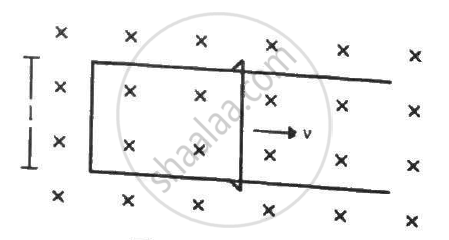
Figure shows a long U-shaped wire of width l placed in a perpendicular magnetic field B. A wire of length l is slid on the U-shaped wire with a constant velocity v towards right. The resistance of all the wires is r per unit length. At t = 0, the sliding wire is close to the left edge of the U-shaped wire. (a) Calculate the force needed to keep the sliding wire moving with a constant velocity v. (b) If the force needed just after t = 0 is F0, find the time at which the force needed will be F0/2.0
Advertisements
उत्तर
Emf induced in the circuit, e = Bvl
Current in the circuit,
\[i = \frac{e}{R} = \frac{Bvl}{2r(l + vt)}\]
(a) Force F needed to keep the sliding wire moving with a constant velocity v will be equal in magnitude to the magnetic force on it. The direction of force F will be along the direction of motion of the sliding wire.
Thus, the magnitude of force F is given by
\[F = ilB = \frac{Bvl}{2r(l + vt)} \times lB\]
\[ = \frac{B^2 l^2 v}{2r(l + vt)}\]
(b) The magnitude of force F at t = 0 is given by
\[F_0 = ilB = lB\left( \frac{lBv}{2rl} \right) \]
\[ = \frac{l B^2 v}{2r} .............(1)\]
Let at time t = T, the value of the force be F0/2.
Now,
\[\frac{F_0}{2} = \frac{l^2 B^2 v}{2r(l + vT)}\]
On substituting the value of F0 from (1), we get
\[\frac{l B^2 v}{4r} = \frac{l^2 B^2 v}{2r(l + vT)}\]
\[ \Rightarrow 2l = l + vT\]
\[ \Rightarrow T = \frac{l}{v}\]
APPEARS IN
संबंधित प्रश्न
The device used for producing electric current is called _________.
The phenomenon of electromagnetic induction is
A circular coil of cross-sectional area 200 cm2 and 20 turns is rotated about the vertical diameter with angular speed of 50 rad s−1 in a uniform magnetic field of magnitude 3.0 × 10⁻²T. Calculate the maximum value of the current in the coil.
When an electric current is passed through any wire, a magnetic field is produced around it. Then why an electric iron connecting cable does not attract nearby iron objects when electric current switched on through it?
What do you understand by the term "electromagnetic induction"? Explain with the help of a diagram.
How is the working of an electric bell affected, if alternating current be used instead of direct current?
Show diagrammatically how an alternating emf is generated by a loop of wire rotating in a magnetic field. Write the expression for the instantaneous value of the emf induced in the rotating loop.
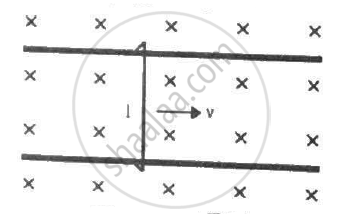
Figure shows a wire sliding on two parallel, conducting rails placed at a separation l. A magnetic field B exists in a direction perpendicular to the plane of the rails. What force is necessary to keep the wire moving at a constant velocity v?
Fill in the blanks by writing (i) Only soft iron, (ii) Only steel, (iii) Both soft-iron and steel for the material of core and/or magnet.
D.C. motor ______.
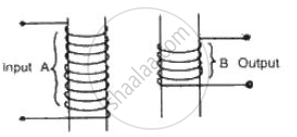
Complete the following diagram of a transformer and name the parts labeled A and B. Name the part you have drawn to complete the diagram . What is the material of this part? In this transformer a step-up or step-down? Why?
A straight metal wire crosses a magnetic field of flux 4 mWb in a time 0.4 s. Find the magnitude of the emf induced in the wire.
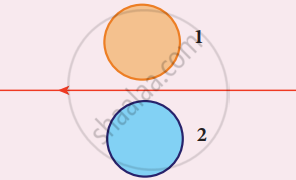
Using Lenz’s law, predict the direction of induced current in conducting rings 1 and 2 when the current in the wire is steadily decreasing.
The condition for the praenomen of electromagnetic induction is that there must be a relative motion between ____________.
Ansari Sir was demonstrating an experiment in his class with the setup as shown in the figure below.

A magnet is attached to a spring. The magnet can go in and out of the stationary coil. He lifted the Magnet and released it to make it oscillate through the coil.
Based on your understanding of the phenomenon, answer the following question.
What will be observed when the Magnet starts oscillating through the coil. Explain the reason behind this observation.
Which of the following instruments works by electromagnetic induction?
A coil of one turn is made of a wire of certain length and then from the same length, a coil of two turns is made. If the same current is passed in both the cases, then the ratio of the magnetic inductions at their centres will be:
AB is a coil of copper wire having a large number of turns. The ends of the coil are connected with a galvanometer as shown. When the north pole of a strong bar magnet is moved towards end B of the coil, a deflection is observed in the galvanometer.

- State the reason for using galvanometer in the activity and why does its needle deflects momentarily when magnet is moved towards the coil.
- What would be observed in the galvanometer in a situation when the coil and the bar magnet both move with the same speed in the same direction? Justify your answer.
- State the conclusion that can be drawn from this activity.
Will there be any change in the momentary deflection in the galvanometer if number of turns in the coil is increased and a more stronger magnet is moved towards the coil?
OR
What is electromagnetic induction? What is observed in the galvanometer when a strong bar magnet is held stationary near one end of a coil of large number of turns? Justify your answer.
The charge will flow through a galvanometer of resistance 200Ω connected to a 400Ω circular coil of 1000 turns wound on a wooden stick 20 mm in diameter, if a magnetic field B = 0.012 T parallel to the axis of the stick decreased suddenly to zero, is near ______.
Which type of force is experienced by a moving charge in a magnetic field?
What do moving electric charges produce?
