Advertisements
Advertisements
प्रश्न
Obtain an expression for motional emf from Lorentz force.
Advertisements
उत्तर
Consider a straight conducting rod AB of length l in a uniform magnetic field `vec"B"` which is directed perpendicularly into the plane of the paper. The length of the rod is normal to the magnetic field. Let the rod move with a constant velocity `vec"v"` towards right side.
When the rod moves, the free electrons present in it also move with same velocity `vec"v"` in `vec"B"`. As a result, the Lorentz force acts on free electrons in the direction from B to A and is given by the relation
`vec"F"_"B" = - "e"(vec"v" xx vec"B")` ....(1)
The action of this Lorentz force is to accumulate the free electrons at the end A. This accumulation of free electrons produces a potential difference across the rod which in turn establishes an electric field E directed along BA. Due to the electric field E, the coulomb force starts acting on the free electrons along AB and is given by
`vec"F"_"E" = - "e"vec"E"` ....(2)
The magnitude of the electric field `vec"E"` keeps on increasing as long as the accumulation of electrons at the end A continues. The force `vec"F"_"E"` also increases until equilibrium is reached. At equilibrium, the magnetic Lorentz force `vec"F"_"B"` and the coulomb force `vec"F"_"E"` balance each other and no further accumulation of free electrons at the end A takes place, i.e.,
`|vec"F"_"B"| = |vec"F"_"E"|`
`|-"e" (vec"v" xx vec"B")| = |-"e" vec"E"|`
vB sin 90° = E
vB = E ……. (3)
The potential difference between two ends of the rod is
(a) 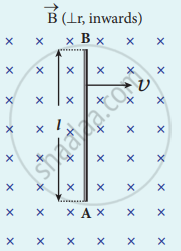
(b)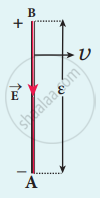
Motional emf from Lorentz force
V = El
V = vBl
Thus the Lorentz force on the free electrons is responsible to maintain this potential difference and hence produces an emf.
ε = Blv ….. (4)
As this emf is produced due to the movement of the rod, it is often called as motional emf.
APPEARS IN
संबंधित प्रश्न
Prove theoretically (electromagnetic induction) `e = (dphi)/(dt)`
What is an electromagnet? Describe the construction and working of an electromagnet with the help of a labelled diagram.
When current is 'switched on' and 'switched off' in a coil, a current is induced in another coil kept near it. What is this phenomenon known as?
How is the working of an electric bell affected, if alternating current be used instead of direct current?
- What kind of energy change takes place when a magnet is moved towards a coil having a galvanometer at its ends?
- Name the phenomenon.
When Puja, a student of 10th class, watched her mother washing clothes in the open, she observed coloured soap bubbles and was curious to know why the soap bubbles appear coloured. In the evening when her father, an engineer by profession, came home, she asked him this question. Her father explained to her the basic phenomenon of physics due to which the soap bubbles appear coloured.
(a) What according to you are the values displayed by Puja and her father?
(b) State the phenomenon of light involved in the formation of coloured soap bubbles.
Write Fleming’s right hand thumb rule with the help of diagram.
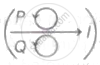
Metal rings P and Q are lying in the same plane, where current I is increasing steadily. The induced current in metal rings is shown correctly in figure.
A cylindrical bar magnet (A) and similar unmagnetized cylindrical iron bar (B) are dropped through metallic pipe. The time taken to come down by ____________.
