Advertisements
Advertisements
प्रश्न
What is an electromagnet? What do you know about the simplest form of an electromagnet?
Advertisements
उत्तर

The electromagnet is a temporary magnet which can be magnetized or demagnetized in a very short time as per our requirements. In the simplest form, an electromagnet consists simply of a soft iron core around which a large number of turns of insulated wire are wound. Two of the simple forms of an electro magnet are shown in the figure alongside.
संबंधित प्रश्न
State Fleming’s right-hand rule.
A horizontal straight wire 10 m long extending from east to west is falling with a speed of 5.0 m s−1, at right angles to the horizontal component of the earth’s magnetic field, 0.30 × 10⁻⁴ Wb m−2.
- What is the instantaneous value of the emf induced in the wire?
- What is the direction of the emf?
- Which end of the wire is at the higher electrical potential?
The north-south polarities of an electromagnet can be found easily by using:
(a) Fleming's right-hand rule
(b) Fleming's left-hand rule
(c) Clock face rule
(d) Left-hand thumb rule
A conducting rod is moved with a constant velocity v in a magnetic field. A potential difference appears across the two ends _____________ .
A conducting square loop having edges of length 2.0 cm is rotated through 180° about a diagonal in 0.20 s. A magnetic field B exists in the region which is perpendicular to the loop in its initial position. If the average induced emf during the rotation is 20 mV, find the magnitude of the magnetic field.
Can a transformer work when it is connected to a D.C. source? Give a reason.
What is an electromagnet?
What should be the core of an electromagnet?
Sea turtles return to their birth beach many decades after they were born due to ______.
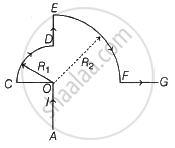
In the current carrying conductor (AOCDEFG) as shown, the magnetic induction at point O is ______.
(R1 and R2 are radii of CD and EF respectively. l = current in the loop, μ0 = permeability of free space)