Advertisements
Advertisements
प्रश्न
A metal rod `1/sqrtpi `m long rotates about one of its ends perpendicular to a plane whose magnetic induction is 4 x 10⁻³ T. Calculate the number of revolutions made by the rod per second if the e.m.f. induced between the ends of the rod is 16 mV.
Advertisements
उत्तर
`L=1/sqrtpim="radius"`
B = 4x10⁻³T
e = 16mv
=16x10-3v
Area covered in one revolution
A=πL2
`=pi(1/sqrtpi)^2`
=1m2
e=BfA
`:.f=e/(BA)`
`=(16xx10^(-3))/(4xx10^(-3)xx1)`
f=4Hz
APPEARS IN
संबंधित प्रश्न
Electric field intensity in free space at a distance ‘r’ outside the charged conducting sphere of radius ‘R’ in terms of surface charge density ‘ a ’ is............................
(a)`sigma / in_0[R/r]^2`
(b)`in_0/sigma[R/r]^2`
(c)`R/r[sigma/in_0]^2`
(d)`R/sigma[r/in_0]^2`
Explain different ways to induce current in a coil.
The phenomenon of electromagnetic induction is
A rectangular wire loop of sides 8 cm and 2 cm with a small cut is moving out of a region of uniform magnetic field of magnitude 0.3 T directed normal to the loop. What is the emf developed across the cut if the velocity of the loop is 1 cm s−1 in a direction normal to the
- longer side,
- shorter side of the loop?
For how long does the induced voltage last in each case?
It is desired to measure the magnitude of field between the poles of a powerful loud speaker magnet. A small flat search coil of area 2 cm2 with 25 closely wound turns, is positioned normal to the field direction, and then quickly snatched out of the field region. Equivalently, one can give it a quick 90° turn to bring its plane parallel to the field direction. The total charge flown in the coil (measured by a ballistic galvanometer connected to coil) is 7.5 mC. The combined resistance of the coil and the galvanometer is 0.50 Ω. Estimate the field strength of magnet.
When an electric current is passed through any wire, a magnetic field is produced around it. Then why an electric iron connecting cable does not attract nearby iron objects when electric current switched on through it?
How does an electromagnet differ forma permanent magnet?
Explain why, an electromagnet is called a temporary magnet.
Write some of the important uses of electromagnets.
The direction of current in the coil at one end of an electromagnet is clockwise. This end of the electromagnet will be:
(a) north pole
(b) east pole
(c) south pole
(d) west pole
State whether the following statement are true or false:
A generator works on the principle of electromagnetic induction.
When a wire is moved up and down in a magnetic field, a current is induced in the wire. What is this phenomenon known as?
Describe different ways to induce current in a coil of wire.
In which of the following case does the electromagnetic induction occur?
A loop of wire is held near a magnet.
Name and state the law which determines the direction of induced current.
or
State Fleming’s right-hand rule.
Show diagrammatically how an alternating emf is generated by a loop of wire rotating in a magnetic field. Write the expression for the instantaneous value of the emf induced in the rotating loop.
A conducting square loop of side l and resistance R moves in its plane with a uniform velocity v perpendicular to one of its sides. A uniform and constant magnetic field Bexists along the perpendicular to the plane of the loop as shown in figure. The current induced in the loop is _____________ .
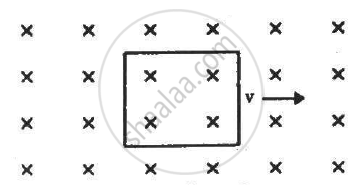
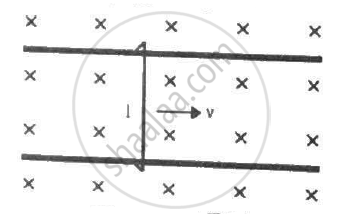
Figure shows a wire sliding on two parallel, conducting rails placed at a separation l. A magnetic field B exists in a direction perpendicular to the plane of the rails. What force is necessary to keep the wire moving at a constant velocity v?
Can a transformer work when it is connected to a D.C. source? Give a reason.
Draw a simple labeled diagram of a step-down transformer.
The diagram 10 shows two coils X and Y. The coil X is connected to a battery S and a key K. The coil Y is connected to a galvanometer G.
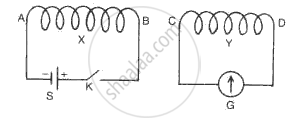
When the key K is closed. State the polarity
(i)At the end of the coil X,
(ii)At the end C of the coil Y,
(iii)At the end C of the coil Y if the coil Y is (a) Moved towards the coil X, (b) Moved away from the coil X.
Draw and label the diagram of a simple D.C. motor.
(a) Explain the rotation of the coil, giving a reason for your answer.
(b) How can you reverse the direction of rotation of the armature?
(c) How can you increase the speed of rotation of the motor?
Fig. shows a simple form of an A.C. generator.
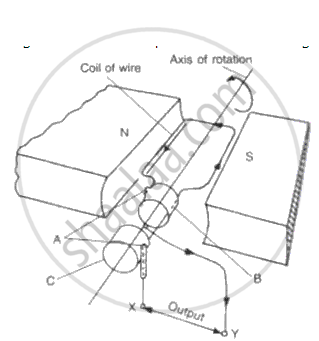
(a) Name the parts labeled A and B.
(b) What would be the effect of doubling the number of turns on the coil if the speed of rotation remains unchanged?
(c) Which of the output terminals is positive if the coil is rotating in the
direction shown in the diagram (anticlockwise)?
( d ) What is the position of the rotating coil when p.d. across its ends is zero? Explain why p.d. is zero when the coil is at this position .
(e) Sketch a graph showing how the p.d. across the ends of the rotating coil varies with time for an A.C. dynamo.
( f) On th e same sheet of paper and vertically below the first graph using the same time scale, sketch graphs to show the effect of
(i) Doubling the speed of rotation and at the same time keeping
the field and the number of turns constant,
(ii ) Doubling the number of turns on the coil and at the same time
doubling the speed of rotation of the coil, keeping th e speed
constant.
Fill in the blanks by writing (i) Only soft iron, (ii) Only steel, (iii) Both soft-iron and steel for the material of core and/or magnet.
D.C. motor ______.
Fill in the blanks by writing (i) Only soft iron, (ii) Only steel, (iii) Both soft-iron and steel for the material of core and/or magnet.
Transformer______.
Name the following diagram and explain the concept behind it.
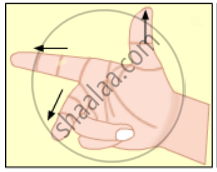
Answer the following:
State the principles of the electric motor and electric generator.
What is an electromagnet?
List some of the practical applications of an electromagnet.
What is an electromagnet? What do you know about the simplest form of an electromagnet?
Draw a labelled diagram to make an electromagnet from a soft iron bar. Mark the polarity at its ends in your diagram. What precaution would you observe while making it?
You have been provided with a solenoid AB.
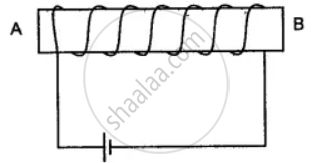
(i) What is the polarity at end A?
(ii) Give one advantage of an electromagnet over a permanent magnet.
Choose the correct option:
A conductor rod of length (l) is moving with velocity (v) in a direction normal to a uniform magnetic field (B). What will be the magnitude of induced emf produced between the ends of the moving conductor?
The energy stored in a 50 mH inductor carrying a current of 4 A is ______
Fleming's left hand rule : electric current : : Fleming's right hand rule : _______
A thin semi-circular conducting ring (PQR) of radius r is falling with its plane vertical in a horizontal magnetic field B, as shown in the figure.
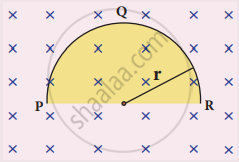
The potential difference developed across the ring when its speed v , is
A square coil of side 30 cm with 500 turns is kept in a uniform magnetic field of 0.4 T. The plane of the coil is inclined at an angle of 30° to the field. Calculate the magnetic flux through the coil.
A straight metal wire crosses a magnetic field of flux 4 mWb in a time 0.4 s. Find the magnitude of the emf induced in the wire.
A coil of 200 turns carries a current of 0.4 A. If the magnetic flux of 4 mWb is linked with each turn of the coil, find the inductance of the coil.
An alternating emf of 0.2 V is applied across an L-C-R series circuit having R = 4Q, C = 80µF, and L = 200 mH. At resonance the voltage drop across the inductor is
A metal plate can be heated by ______.
If the sun radiates energy at the rate of 3.6 × 1033 ergs/sec the rate at which the sun is loosing mass is given by ______.
For making a strong electromagnet the material of the core should be ______.
A 0.4 m wire, stretched horizontally, carries an electric current of 15 A, in a magnetic field whose magnetic field intensity is 0.1 N/Am. What is the magnitude of the wire?
A current I = 10 sin(100π t) A is passed in first coil, which induces a maximum e.m.f of 5π volt in second coil. The mutual inductance between the coils is ______.
One solenoid is centered inside another. The outer one has a length of 50.0 cm and contains 6750 coils, while the coaxial inner solenoid is 3.0 cm long and π cm2 in area and contains 150 coils. The current in the outer solenoid is changing at 3000 A/s. The emf induced in the inner solenoid is ______ V.
(Round off to two decimal places.)
The primary of a transformer has 400 turns while the secondary has 2000 turns. If the power output from the secondary at 1000 Vis 12 kW, what is the primary voltage?
How were electricity and magnetism considered for a long time?
What do moving electric charges produce?
What did Faraday show in 1831?
What is produced when a magnet moves towards or away from a coil?
What is a coil?
What is a changing magnetic field?
