Advertisements
Advertisements
प्रश्न
Find the odd one out and give its explanation.
विकल्प
Boiler
Electric stove
Electric bulb
Electric bell
Advertisements
उत्तर
Electric bell
Explanation-
Others are used to generate heat energy when it becomes hot whereas electric bell do not produce any heat energy.
APPEARS IN
संबंधित प्रश्न
The magnetic flux through a loop varies according to the relation Φ = 8t2 + 6t + C, where ‘C’ is constant, 'Φ' is in milliweber and 't' is in second. What is the magnitude of induced e.m.f. in the loop at t = 2 seconds.
Two circular coils A and B are placed closed to each other. If the current in the coil A is changed, will some current be induced in the coil B? Give reason.
How does an electromagnet differ forma permanent magnet?
Name two devices in which electromagnets are used and two devices where permanent magnets are used.
Explain why, the core of an electromagnet should be of soft iron and not of steel.
State whether the following statement are true or false:
A generator works on the principle of electromagnetic induction.
Describe different ways to induce current in a coil of wire.
An induced current is produced when a magnet is moved into a coil. The magnitude of induced current does not depend on:
(a) the speed with which the magnet is moved
(b) the number of turns of the coil
(c) the resistivity of the wire of the coil
(d) the strength of the magnet
When the magnet shown in the diagram below is moving towards the coil, the galvanometer gives a reading to the right.
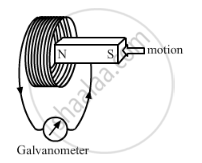
() What is the name of the effect being produced by the moving magnet?
(2) State what happens to the reading shown on the galvanometer when the magnet is moving away from the coil.
(3) The original experiment is repeated. This time the magnet is moved towards the coil at a great speed. State two changes you would notice in the reading on the galvanometer.
Describe one experiment to demonstrate the phenomenon of electromagnetic induction.
In which of the following case does the electromagnetic induction occur?
A loop of wire is held near a magnet.
Welders wear special glass goggles while working. Why? Explain.
The coil of a moving-coil galvanometer keeps on oscillating for a long time if it is deflected and released. If the ends of the coil are connected together, the oscillation stops at once. Explain.
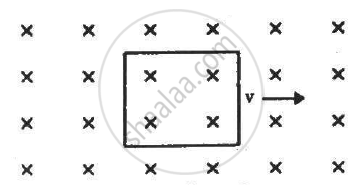
A conducting square loop of side l and resistance R moves in its plane with a uniform velocity v perpendicular to one of its sides. A uniform and constant magnetic field Bexists along the perpendicular to the plane of the loop as shown in figure. The current induced in the loop is _____________ .
State Fleming’s Right Hand Rule.
Why soft iron is preferred to be used as the core of the electromagnet of an electric bell?
Draw a labelled diagram to make an electromagnet from a soft iron bar. Mark the polarity at its ends in your diagram. What precaution would you observe while making it?
You have been provided with a solenoid AB.
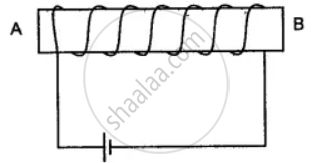
(i) What is the polarity at end A?
(ii) Give one advantage of an electromagnet over a permanent magnet.
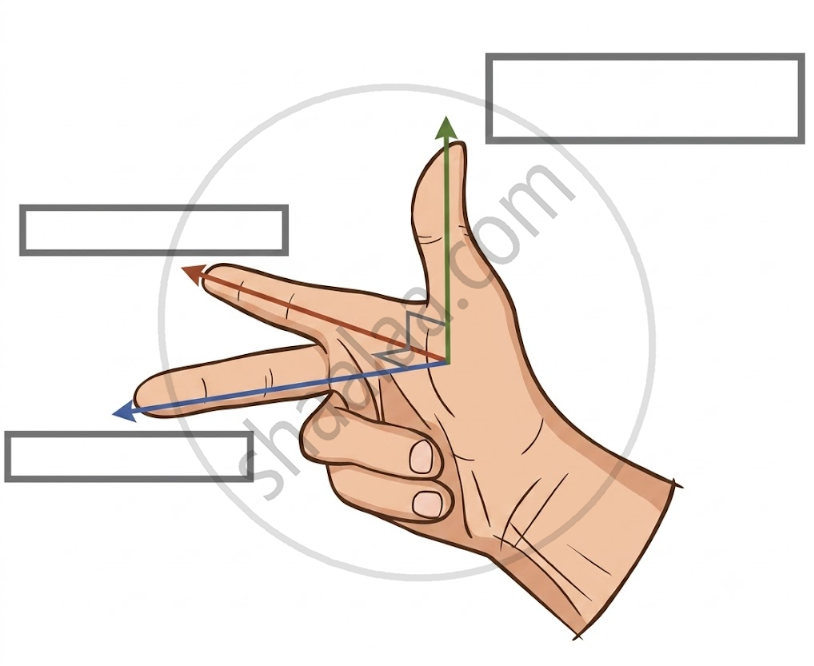
Observe the given figure of Fleming’s Right Hand Rule and write the labels of A and B correctly.
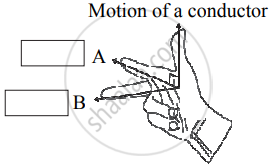
Write Fleming’s right hand thumb rule with the help of diagram.
Write the two names in the following diagram.
Fleming’s right hand rule.
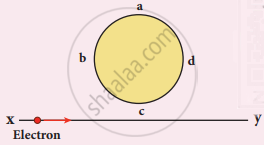
An electron moves on a straight-line path XY as shown in the figure. The coil abcd is adjacent to the path of the electron. What will be the direction of the current, if any, induced in the coil?
Establish the fact that the relative motion between the coil and the magnet induces an emf in the coil of a closed circuit.
A straight metal wire crosses a magnetic field of flux 4 mWb in a time 0.4 s. Find the magnitude of the emf induced in the wire.
A coil of 200 turns carries a current of 0.4 A. If the magnetic flux of 4 mWb is linked with each turn of the coil, find the inductance of the coil.
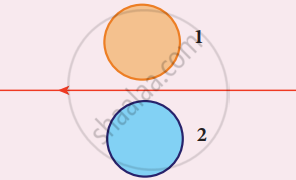
Using Lenz’s law, predict the direction of induced current in conducting rings 1 and 2 when the current in the wire is steadily decreasing.
What should be the core of an electromagnet?
A 0.4 m wire, stretched horizontally, carries an electric current of 15 A, in a magnetic field whose magnetic field intensity is 0.1 N/Am. What is the magnitude of the wire?
In the given circuit, initially switch S1 is closed and S2 and S3 are open. After charging of capacitor, at t = 0, S1 is open and S2 and S3 are closed. If the relation between inductance capacitance and resistance is L = 4CR2 then the time (in sec) after which current passing through capacitor and inductor will be same is ______ × 10-4 N. (Given R = ℓn(2)mΩ, L = 2mH)

A current I = 10 sin(100π t) A is passed in first coil, which induces a maximum e.m.f of 5π volt in second coil. The mutual inductance between the coils is ______.
Show that for a given positive ion species in a cyclotron, (i) the radius of their circular path inside a dee is directly proportional to their speed, and (ii) the maximum ion energy achievable is directly proportional to the square of the magnetic induction.
Which type of force is experienced by a moving charge in a magnetic field?
A sheet is placed on horizontal surface in front of a strong magnetic pole. A force is needed to:
- hold the sheet there if it is magnetic.
- hold the sheet there if it is non-magnetic.
- move the sheet away from the pole with uniform velocity if it is conducting.
- move the sheet away from the pole with uniform velocity if it is both, non-conducting and nonpolar.
Choose the correct statement(s) from the options given below:
What is produced when a magnet moves towards or away from a coil?
Which movement can change the number of magnetic field lines passing through a coil near a solenoid?
What is a solenoid?
Which device used for producing electricity works on electromagnetic induction?
Which group consists entirely of technologies that work on electromagnetic induction?
