Advertisements
Advertisements
प्रश्न
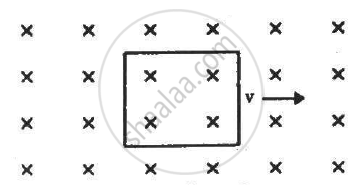
A conducting square loop of side l and resistance R moves in its plane with a uniform velocity v perpendicular to one of its sides. A uniform and constant magnetic field Bexists along the perpendicular to the plane of the loop as shown in figure. The current induced in the loop is _____________ .
विकल्प
Blv/R clockwise
Blv/R anticlockwise
2Blv/R anticlockwise
zero
Advertisements
उत्तर
Zero

Figure (a) shows the square loop moving in its plane with a uniform velocity v.
Figure (b) shows the equivalent circuit.
The induced emf across ends AB and CD is given by
`E=Bvl`
On applying KVL in the equivalent circuit, we get
`E-E+iR=0`
`rArr i=0`
No current will be induced in the circuit due to zero potential difference between the closed ends.
APPEARS IN
संबंधित प्रश्न
State three differences between direct current and alternating current.
Name a common device that uses electromagnets.
Name two devices in which electromagnets are used and two devices where permanent magnets are used.
State whether the following statement are true or false:
A motor works on the principle electric generator?
Welders wear special goggles or face masks with glass windows to protect their eyes from electromagnetic radiations. Name the radiations and write the range of their frequency.
Calculate the dimensions of (a) \[\int \overrightarrow{E} . d \overrightarrow{l,}\] (b) vBl and (c) \[\frac{d \Phi_B}{dt}.\] The symbols have their usual meaning.
A conducting square loop having edges of length 2.0 cm is rotated through 180° about a diagonal in 0.20 s. A magnetic field B exists in the region which is perpendicular to the loop in its initial position. If the average induced emf during the rotation is 20 mV, find the magnitude of the magnetic field.
The diagram 10 shows two coils X and Y. The coil X is connected to a battery S and a key K. The coil Y is connected to a galvanometer G.
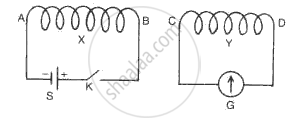
When the key K is closed. State the polarity
(i)At the end of the coil X,
(ii)At the end C of the coil Y,
(iii)At the end C of the coil Y if the coil Y is (a) Moved towards the coil X, (b) Moved away from the coil X.
List two ways of increasing the strength of an electromagnet if the material of the electromagnet is fixed.
The diagram shows a rectangular coil ABCD, suspended freely between the concave pole pieces of a permanent horseshoe magnet, such that the plane of the coil is parallel to the magnetic field.
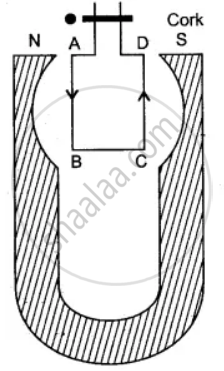
- State your observation when the current is switched on.
- Give an explanation for your observation in (i).
- State the rule, which will help you to find the motion of rotation of the coil.
- In which position will the coil ultimately come to rest?
- State four ways of increasing the magnitude of force acting on the coil.
The right-hand thumb rule is also called _______ rule.
What for an inductor is used? Give some examples.
An alternating emf of 0.2 V is applied across an L-C-R series circuit having R = 4Q, C = 80µF, and L = 200 mH. At resonance the voltage drop across the inductor is
We can induce the current in a coil by ____________.
If the sun radiates energy at the rate of 3.6 × 1033 ergs/sec the rate at which the sun is loosing mass is given by ______.
Sea turtles return to their birth beach many decades after they were born due to ______.
A conducting bar of length L is free to slide on two parallel conducting rails as shown in the figure

Two resistors R1 and R2 are connected across the ends of the rails. There is a uniform magnetic field `vec"B"` pointing into the page. An external agent pulls the bar to the left at a constant speed v. The correct statement about the directions of induced currents I1 and I2 flowing through R1 and R2 respectively is:
What do moving electric charges produce?
