Advertisements
Advertisements
प्रश्न
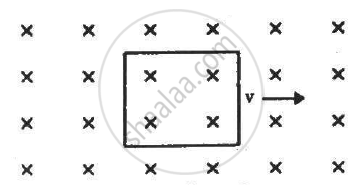
A conducting square loop of side l and resistance R moves in its plane with a uniform velocity v perpendicular to one of its sides. A uniform and constant magnetic field Bexists along the perpendicular to the plane of the loop as shown in figure. The current induced in the loop is _____________ .
पर्याय
Blv/R clockwise
Blv/R anticlockwise
2Blv/R anticlockwise
zero
Advertisements
उत्तर
Zero

Figure (a) shows the square loop moving in its plane with a uniform velocity v.
Figure (b) shows the equivalent circuit.
The induced emf across ends AB and CD is given by
`E=Bvl`
On applying KVL in the equivalent circuit, we get
`E-E+iR=0`
`rArr i=0`
No current will be induced in the circuit due to zero potential difference between the closed ends.
APPEARS IN
संबंधित प्रश्न
Electric field intensity in free space at a distance ‘r’ outside the charged conducting sphere of radius ‘R’ in terms of surface charge density ‘ a ’ is............................
(a)`sigma / in_0[R/r]^2`
(b)`in_0/sigma[R/r]^2`
(c)`R/r[sigma/in_0]^2`
(d)`R/sigma[r/in_0]^2`
State Fleming’s right-hand rule.
The phenomenon of electromagnetic induction is
A rectangular wire loop of sides 8 cm and 2 cm with a small cut is moving out of a region of uniform magnetic field of magnitude 0.3 T directed normal to the loop. What is the emf developed across the cut if the velocity of the loop is 1 cm s−1 in a direction normal to the
- longer side,
- shorter side of the loop?
For how long does the induced voltage last in each case?
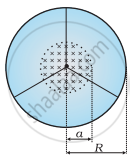
A line charge λ per unit length is lodged uniformly onto the rim of a wheel of mass M and radius R. The wheel has light non-conducting spokes and is free to rotate without friction about its axis (Figure). A uniform magnetic field extends over a circular region within the rim. It is given by,
B = − B0 k (r ≤ a; a < R)
= 0 (otherwise)
What is the angular velocity of the wheel after the field is suddenly switched off?
The direction of current in the coil at one end of an electromagnet is clockwise. This end of the electromagnet will be:
(a) north pole
(b) east pole
(c) south pole
(d) west pole
State whether the following statement are true or false:
A generator works on the principle of electromagnetic induction.
An induced current is produced when a magnet is moved into a coil. The magnitude of induced current does not depend on:
(a) the speed with which the magnet is moved
(b) the number of turns of the coil
(c) the resistivity of the wire of the coil
(d) the strength of the magnet
In which of the following case does the electromagnetic induction occur?
A loop of wire is held near a magnet.
Fill in the blanks by writing (i) Only soft iron, (ii) Only steel, (iii) Both soft-iron and steel for the material of core and/or magnet.
A. C. generator______.
A coil has a self-inductance of 0·05 Henry. Find the magnitude of the emf induced in it when the current flowing through it is changing at the rate of 100 As-1.
State the purpose of soft iron core used in making an electromagnet.
Draw a labelled diagram to make an electromagnet from a soft iron bar. Mark the polarity at its ends in your diagram. What precaution would you observe while making it?
Show that Lenz’s law is in accordance with the law of conservation of energy.
Obtain an expression for motional emf from Lorentz force.
There is a uniform magnetic field directed perpendicular and into the plane of the paper. An irregular shaped conducting loop is slowly changing into a circular loop in the plane of the paper. Then ______.
For making a strong electromagnet the material of the core should be ______.
A conductor of length 50 cm carrying a current of 5 A is placed perpendicular to a magnetic field of induction 2×10 -3T. Find the force on the conductor.
Which scientists established in the early nineteenth century that electricity and magnetism are related?
Which type of motor works on electromagnetic induction?
