Advertisements
Advertisements
प्रश्न
A rectangular wire loop of sides 8 cm and 2 cm with a small cut is moving out of a region of uniform magnetic field of magnitude 0.3 T directed normal to the loop. What is the emf developed across the cut if the velocity of the loop is 1 cm s−1 in a direction normal to the
- longer side,
- shorter side of the loop?
For how long does the induced voltage last in each case?
Advertisements
उत्तर १
Magnetic flux passing through an area A placed perpendicular to the magnetic field B is Φ = BA.
Let the length of the loop be l and width b and the magnitude of its velocity be. As soon as the loop is taken out of the magnetic field perpendicular to the longer side, the area bounded by the field changes, which leads to a change in From Faraday's law, the magnitude of the induced electromotive force is
|e| = `(d phi)/(dt)`
= `d/dt (BA)`
= `B ((dA)/dt)`
Now, `(dA)/dt` = lv ....(Area enclosed by the loop per second)
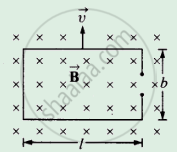

Hence, |e| = Blv = 0.3 weber/m2 × (8 × 10−2 m) × (10−2 m/s)
= 2.4 × 10⁻⁴ weber/second
= 2.4 × 10⁻⁴ Volt
= 0.24 milli volts
The induced potential difference will remain as long as the flux changes. Thus, the time for the potential difference |e| to persist
= `b/v`
= `(2 xx 10^-2 m)/(10^-2 m//s)`
= 2 s
From figure (b), `(dA)/(dT) = (bv)`
|e| = Bbv
= 0.3 × (2 × 10−2) × 10−2
= 0.6 × 10⁻⁴ volt
= 0.06 millivolt
|e| the duration of the = `l/v`
= `(8 xx 10^-2 m)/(10^-2 m//s)`
= 8 s
उत्तर २
Here A = 8 × 2 = 16 cm2 = 16 × 10−4 m2,
B = 0.3 T
v = 1 cm s−1
Induced emf, ε = ?

i. When velocity is normal to longer side,
l = 8 cm = 8 × 10⁻² m
ε = Blv = 0.3 × 8 × 10−2 × 10−2 = 2.4 × 10⁻⁴ V
Time, `t = "distance moved"/"velocity"`
= `(2 xx 10^-2)/10^-2`
= 2 sec
ii. When velocity is normal to longer side,
l = 2 cm = 2 × 10⁻² m
ε = Blv = 0.3 × 8 × 10−2 × 10−2 = 2.4 × 10⁻⁴ V
Time, `t = "distance moved"/"velocity"`
= `(8 xx 10^-2)/10^-2`
= 8 sec
संबंधित प्रश्न
A solenoid of length 1.5 m and 4 cm in diameter possesses 10 turns per metre. A current of 5 A is flowing through it. The magnetic induction at a point inside the solenoid along the axis is ............................. .
(μ0 = 4π × 10-7 Wb/Am)
- π × 10-5 T
- 2π × 10-5 T
- 3π × 10-5 T
- 4π × 10-5 T
The phenomenon of electromagnetic induction is
Prove theoretically (electromagnetic induction) `e = (dphi)/(dt)`
State three ways in which the strength of an electromagnet can be increased.
Welders wear special goggles or face masks with glass windows to protect their eyes from electromagnetic radiations. Name the radiations and write the range of their frequency.
Electromagnetic induction means ______.
The diagram 10 shows two coils X and Y. The coil X is connected to a battery S and a key K. The coil Y is connected to a galvanometer G.
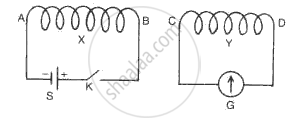
When the key K is closed. State the polarity
(i)At the end of the coil X,
(ii)At the end C of the coil Y,
(iii)At the end C of the coil Y if the coil Y is (a) Moved towards the coil X, (b) Moved away from the coil X.
Fill in the blanks by writing (i) Only soft iron, (ii) Only steel, (iii) Both soft-iron and steel for the material of core and/or magnet.
Transformer______.
What is an electromagnet?
What is an electromagnet? What do you know about the simplest form of an electromagnet?
Establish the fact that the relative motion between the coil and the magnet induces an emf in the coil of a closed circuit.
Show that Lenz’s law is in accordance with the law of conservation of energy.
A square coil of side 30 cm with 500 turns is kept in a uniform magnetic field of 0.4 T. The plane of the coil is inclined at an angle of 30° to the field. Calculate the magnetic flux through the coil.
We can induce the current in a coil by ____________.
A galvanometer is an instrument that can detect the presence of a current in a circuit.
The primary of a transformer has 400 turns while the secondary has 2000 turns. If the power output from the secondary at 1000 Vis 12 kW, what is the primary voltage?
The charge will flow through a galvanometer of resistance 200Ω connected to a 400Ω circular coil of 1000 turns wound on a wooden stick 20 mm in diameter, if a magnetic field B = 0.012 T parallel to the axis of the stick decreased suddenly to zero, is near ______.
Which scientists established in the early nineteenth century that electricity and magnetism are related?
