Advertisements
Advertisements
प्रश्न
A rectangular wire loop of sides 8 cm and 2 cm with a small cut is moving out of a region of uniform magnetic field of magnitude 0.3 T directed normal to the loop. What is the emf developed across the cut if the velocity of the loop is 1 cm s−1 in a direction normal to the
- longer side,
- shorter side of the loop?
For how long does the induced voltage last in each case?
Advertisements
उत्तर १
Magnetic flux passing through an area A placed perpendicular to the magnetic field B is Φ = BA.
Let the length of the loop be l and width b and the magnitude of its velocity be. As soon as the loop is taken out of the magnetic field perpendicular to the longer side, the area bounded by the field changes, which leads to a change in From Faraday's law, the magnitude of the induced electromotive force is
|e| = `(d phi)/(dt)`
= `d/dt (BA)`
= `B ((dA)/dt)`
Now, `(dA)/dt` = lv ....(Area enclosed by the loop per second)
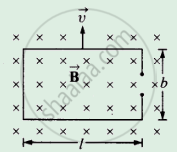

Hence, |e| = Blv = 0.3 weber/m2 × (8 × 10−2 m) × (10−2 m/s)
= 2.4 × 10⁻⁴ weber/second
= 2.4 × 10⁻⁴ Volt
= 0.24 milli volts
The induced potential difference will remain as long as the flux changes. Thus, the time for the potential difference |e| to persist
= `b/v`
= `(2 xx 10^-2 m)/(10^-2 m//s)`
= 2 s
From figure (b), `(dA)/(dT) = (bv)`
|e| = Bbv
= 0.3 × (2 × 10−2) × 10−2
= 0.6 × 10⁻⁴ volt
= 0.06 millivolt
|e| the duration of the = `l/v`
= `(8 xx 10^-2 m)/(10^-2 m//s)`
= 8 s
उत्तर २
Here A = 8 × 2 = 16 cm2 = 16 × 10−4 m2,
B = 0.3 T
v = 1 cm s−1
Induced emf, ε = ?

i. When velocity is normal to longer side,
l = 8 cm = 8 × 10⁻² m
ε = Blv = 0.3 × 8 × 10−2 × 10−2 = 2.4 × 10⁻⁴ V
Time, `t = "distance moved"/"velocity"`
= `(2 xx 10^-2)/10^-2`
= 2 sec
ii. When velocity is normal to longer side,
l = 2 cm = 2 × 10⁻² m
ε = Blv = 0.3 × 8 × 10−2 × 10−2 = 2.4 × 10⁻⁴ V
Time, `t = "distance moved"/"velocity"`
= `(8 xx 10^-2)/10^-2`
= 8 sec
संबंधित प्रश्न
Prove theoretically (electromagnetic induction) `e = (dphi)/(dt)`
If ‘R’ is the radius of dees and ‘B’ be the magnetic field of induction in which positive charges (q) of mass (m) escape from the cyclotron, then its maximum speed (vmax) is _______.
A) `(qR)/(Bm)`
B)`(qm)/(Br)`
C) `(qBR)/m`
D) `m/(qBR)`
Name two devices in which electromagnets are used and two devices where permanent magnets are used.
Write some of the important uses of electromagnets.
When a wire is moved up and down in a magnetic field, a current is induced in the wire. What is this phenomenon known as?
In which of the following case does the electromagnetic induction occur?
The current is stopped in a wire held near a loop of wire .
Name and state the law which determines the direction of induced current.
or
State Fleming’s right-hand rule.
Show diagrammatically how an alternating emf is generated by a loop of wire rotating in a magnetic field. Write the expression for the instantaneous value of the emf induced in the rotating loop.
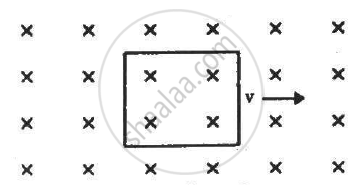
A conducting square loop of side l and resistance R moves in its plane with a uniform velocity v perpendicular to one of its sides. A uniform and constant magnetic field Bexists along the perpendicular to the plane of the loop as shown in figure. The current induced in the loop is _____________ .
Draw a simple labeled diagram of a step-down transformer.
Fill in the blanks by writing (i) Only soft iron, (ii) Only steel, (iii) Both soft-iron and steel for the material of core and/or magnet.
Transformer______.
State Fleming’s Right Hand Rule.
What is an electromagnet? What do you know about the simplest form of an electromagnet?
The energy stored in a 50 mH inductor carrying a current of 4 A is ______
Establish the fact that the relative motion between the coil and the magnet induces an emf in the coil of a closed circuit.
The condition for the praenomen of electromagnetic induction is that there must be a relative motion between ____________.
The instrument that use to defect electric current in the circuit is known as ____________.
Around 1830, who showed that an electric current can be induced in a closed coil exposed to a changing magnetic field?
