Advertisements
Advertisements
प्रश्न
An induced current of 2.5 mA flows through a single conductor of resistance 100 Ω. Find out the rate at which the magnetic flux is cut by the conductor.
Advertisements
उत्तर
Given data:
Induced current i = 2.5 mA
i= 2.5 × 10⁻³ A
Resistance R = 100Ω
ε = `("d"phi_"B")/"dt"`
where ε = iR
`therefore ("d"phi_"B")/"dt"` = iR = 2.5 × 10-3 × 100
= 250 × 10-3
= 250 mWbs-1
APPEARS IN
संबंधित प्रश्न
The magnetic flux through a loop is varying according to a relation `phi = 6t^2 + 7t + 1` where `phi` is in milliweber and t is in second. What is the e.m.f. induced in the loop at t = 2 second?
When an electric current is passed through any wire, a magnetic field is produced around it. Then why an electric iron connecting cable does not attract nearby iron objects when electric current switched on through it?
When the magnet shown in the diagram below is moving towards the coil, the galvanometer gives a reading to the right.
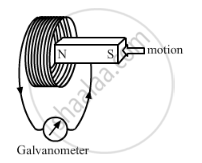
() What is the name of the effect being produced by the moving magnet?
(2) State what happens to the reading shown on the galvanometer when the magnet is moving away from the coil.
(3) The original experiment is repeated. This time the magnet is moved towards the coil at a great speed. State two changes you would notice in the reading on the galvanometer.
A transformer has 400 turns in the primary winding and 10 turns in the secondary winding. The primary e.m.f. is 250 V and the primary current is 2.0 A. calculate:
(a) The secondary voltage,
(b) The secondary current, assuming 100% efficiency.
State Fleming’s Right Hand Rule.
Using Ampere's law, obtain an expression for the magnetic induction near a current-carrying straight infinitely long wire.
A layer of atmosphere that reflects medium frequency radio waves which is ineffective during night, is ______.
A cylindrical bar magnet (A) and similar unmagnetized cylindrical iron bar (B) are dropped through metallic pipe. The time taken to come down by ____________.
A rectangular, a square, a circular and an elliptical loop, all in the (x - y) plane, are moving out of a uniform magnetic field with a constant velocity `vecv = vhati`. The magnetic field is directed along the negative z-axis direction. The induced emf, during the passage of these loops, out of the field region, will not remain constant for ______.
