Advertisements
Advertisements
Question
An induced current of 2.5 mA flows through a single conductor of resistance 100 Ω. Find out the rate at which the magnetic flux is cut by the conductor.
Advertisements
Solution
Given data:
Induced current i = 2.5 mA
i= 2.5 × 10⁻³ A
Resistance R = 100Ω
ε = `("d"phi_"B")/"dt"`
where ε = iR
`therefore ("d"phi_"B")/"dt"` = iR = 2.5 × 10-3 × 100
= 250 × 10-3
= 250 mWbs-1
APPEARS IN
RELATED QUESTIONS
Explain why, the core of an electromagnet should be of soft iron and not of steel.
When current is 'switched on' and 'switched off' in a coil, a current is induced in another coil kept near it. What is this phenomenon known as?
In which of the following case does the electromagnetic induction occur?
The current is stopped in a wire held near a loop of wire .
A light metal disc on the top of an electromagnet is thrown up as the current is switched on. Why? Give reason.
Draw and label the diagram of a simple D.C. motor.
(a) Explain the rotation of the coil, giving a reason for your answer.
(b) How can you reverse the direction of rotation of the armature?
(c) How can you increase the speed of rotation of the motor?
Write Fleming’s right hand thumb rule with the help of diagram.
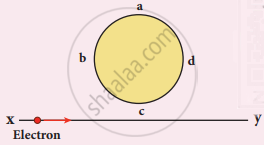
An electron moves on a straight-line path XY as shown in the figure. The coil abcd is adjacent to the path of the electron. What will be the direction of the current, if any, induced in the coil?
A square coil of side 30 cm with 500 turns is kept in a uniform magnetic field of 0.4 T. The plane of the coil is inclined at an angle of 30° to the field. Calculate the magnetic flux through the coil.
The condition for the praenomen of electromagnetic induction is that there must be a relative motion between ____________.
What change can produce a current in a stationary conductor?
