Advertisements
Advertisements
Question
A rectangular wire loop of sides 8 cm and 2 cm with a small cut is moving out of a region of uniform magnetic field of magnitude 0.3 T directed normal to the loop. What is the emf developed across the cut if the velocity of the loop is 1 cm s−1 in a direction normal to the
- longer side,
- shorter side of the loop?
For how long does the induced voltage last in each case?
Advertisements
Solution 1
Magnetic flux passing through an area A placed perpendicular to the magnetic field B is Φ = BA.
Let the length of the loop be l and width b and the magnitude of its velocity be. As soon as the loop is taken out of the magnetic field perpendicular to the longer side, the area bounded by the field changes, which leads to a change in From Faraday's law, the magnitude of the induced electromotive force is
|e| = `(d phi)/(dt)`
= `d/dt (BA)`
= `B ((dA)/dt)`
Now, `(dA)/dt` = lv ....(Area enclosed by the loop per second)
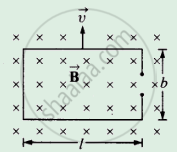

Hence, |e| = Blv = 0.3 weber/m2 × (8 × 10−2 m) × (10−2 m/s)
= 2.4 × 10⁻⁴ weber/second
= 2.4 × 10⁻⁴ Volt
= 0.24 milli volts
The induced potential difference will remain as long as the flux changes. Thus, the time for the potential difference |e| to persist
= `b/v`
= `(2 xx 10^-2 m)/(10^-2 m//s)`
= 2 s
From figure (b), `(dA)/(dT) = (bv)`
|e| = Bbv
= 0.3 × (2 × 10−2) × 10−2
= 0.6 × 10⁻⁴ volt
= 0.06 millivolt
|e| the duration of the = `l/v`
= `(8 xx 10^-2 m)/(10^-2 m//s)`
= 8 s
Solution 2
Here A = 8 × 2 = 16 cm2 = 16 × 10−4 m2,
B = 0.3 T
v = 1 cm s−1
Induced emf, ε = ?

i. When velocity is normal to longer side,
l = 8 cm = 8 × 10⁻² m
ε = Blv = 0.3 × 8 × 10−2 × 10−2 = 2.4 × 10⁻⁴ V
Time, `t = "distance moved"/"velocity"`
= `(2 xx 10^-2)/10^-2`
= 2 sec
ii. When velocity is normal to longer side,
l = 2 cm = 2 × 10⁻² m
ε = Blv = 0.3 × 8 × 10−2 × 10−2 = 2.4 × 10⁻⁴ V
Time, `t = "distance moved"/"velocity"`
= `(8 xx 10^-2)/10^-2`
= 8 sec
RELATED QUESTIONS
State three differences between direct current and alternating current.
When a bar magnet is pushed towards (or away) from the coil connected to a galvanometer, the pointer in the galvanometer deflects. Identify the phenomenon causing this deflection and write the factors on which the amount and direction of the deflection depends. State the laws describing this phenomenon.
Explain different ways to induce current in a coil.
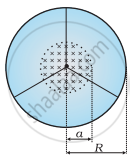
A line charge λ per unit length is lodged uniformly onto the rim of a wheel of mass M and radius R. The wheel has light non-conducting spokes and is free to rotate without friction about its axis (Figure). A uniform magnetic field extends over a circular region within the rim. It is given by,
B = − B0 k (r ≤ a; a < R)
= 0 (otherwise)
What is the angular velocity of the wheel after the field is suddenly switched off?
If ‘R’ is the radius of dees and ‘B’ be the magnetic field of induction in which positive charges (q) of mass (m) escape from the cyclotron, then its maximum speed (vmax) is _______.
A) `(qR)/(Bm)`
B)`(qm)/(Br)`
C) `(qBR)/m`
D) `m/(qBR)`
Name two devices in which electromagnets are used and two devices where permanent magnets are used.
Explain why, the core of an electromagnet should be of soft iron and not of steel.
The north-south polarities of an electromagnet can be found easily by using:
(a) Fleming's right-hand rule
(b) Fleming's left-hand rule
(c) Clock face rule
(d) Left-hand thumb rule
State whether the following statement are true or false:
A generator works on the principle of electromagnetic induction.
Name and state the law which determines the direction of induced current.
or
State Fleming’s right-hand rule.
Consider the energy density in a solenoid at its centre and that near its ends. Which of the two is greater?
Fill in the blanks by writing (i) Only soft iron, (ii) Only steel, (iii) Both soft-iron and steel for the material of core and/or magnet.
D.C. motor ______.
Fill in the blanks by writing (i) Only soft iron, (ii) Only steel, (iii) Both soft-iron and steel for the material of core and/or magnet.
A. C. generator______.
A thin semi-circular conducting ring (PQR) of radius r is falling with its plane vertical in a horizontal magnetic field B, as shown in the figure.
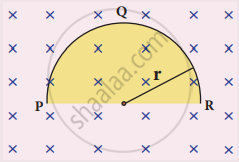
The potential difference developed across the ring when its speed v , is
Show that Lenz’s law is in accordance with the law of conservation of energy.
An expression for oscillating electric field in a plane electromagnetic wave is given as Ez = 300 sin(5π × 103x - 3π × 1011t)Vm-1 Then, the value of magnetic field amplitude will be ______. (Given: speed of light in Vacuum c = 3 × 10⁸ ms-1)
What happens when the current in a nearby solenoid coil is switched on or off?
What is a changing magnetic field?
