Advertisements
Advertisements
प्रश्न
Describe one experiment to demonstrate the phenomenon of electromagnetic induction.
Advertisements
उत्तर
| (a) | 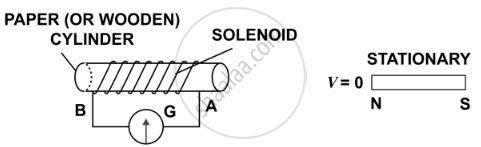 |
| (b) | 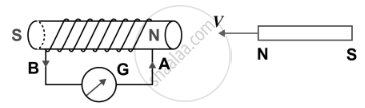 |
| (c) | 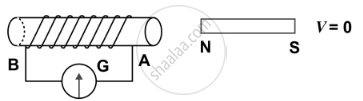 |
| (d) | 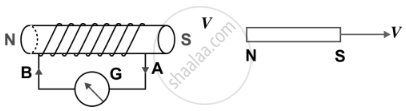 |
| (e) | 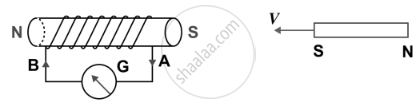 |
- When the magnet is stationary there is no deflection in galvanometer. The pointer read zero. [Fig. (a)]
- When the magnet with north pole facing the solenoid is moved towards the solenoid, the galvanometer shows a deflection towards the right showing that a current flows in the solenoid in the direction as shown in [Fig. (b)]
- As the motion of magnet stops, the pointer of the galvanometer comes to the zero position [Fig. (c)]. This shows that the current in the solenoid flows as long as the magnet is moving.
- If the magnet is moved away from the solenoid, the current again flows in the solenoid, but now in a direction opposite to that shown in [Fig. (b)] and therefore the pointer of the galvanometer deflects towards left [Fig. (d)].
- If the magnet is moved away rapidly i.e. with more velocity, the extent of deflection in the galvanometer increases although the direction of deflection remains the same. It shows that more current flows now.
- (vi) If the polarity of the magnet is reversed and then the magnet is brought towards the solenoid, the current in solenoid flows in the direction opposite to that shown in Fig. (b) and so the pointer of galvanometer deflect towards left [Fig. (e)].
APPEARS IN
संबंधित प्रश्न
It is desired to measure the magnitude of field between the poles of a powerful loud speaker magnet. A small flat search coil of area 2 cm2 with 25 closely wound turns, is positioned normal to the field direction, and then quickly snatched out of the field region. Equivalently, one can give it a quick 90° turn to bring its plane parallel to the field direction. The total charge flown in the coil (measured by a ballistic galvanometer connected to coil) is 7.5 mC. The combined resistance of the coil and the galvanometer is 0.50 Ω. Estimate the field strength of magnet.
What is an electromagnet? Describe the construction and working of an electromagnet with the help of a labelled diagram.
What condition is necessary for the production of current by electromagnetic induction?
In which of the following case does the electromagnetic induction occur?
The current is stopped in a wire held near a loop of wire .
A galvanometer is an instrument that can detect the presence of a current in a circuit.
A 0.4 m wire, stretched horizontally, carries an electric current of 15 A, in a magnetic field whose magnetic field intensity is 0.1 N/Am. What is the magnitude of the wire?
A current I = 10 sin(100π t) A is passed in first coil, which induces a maximum e.m.f of 5π volt in second coil. The mutual inductance between the coils is ______.
When an electric current is passed through a wire or a coil, a magnetic field is produced. Is the reverse phenomenon possible i.e, can a magnetic field produce an electric current? Explain with the help of an appropriate example.
How were electricity and magnetism considered for a long time?
What happens when the current in a nearby solenoid coil is switched on or off?
