Advertisements
Advertisements
प्रश्न
Describe one experiment to demonstrate the phenomenon of electromagnetic induction.
Advertisements
उत्तर
| (a) | 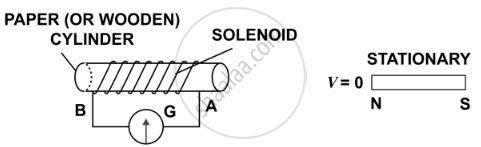 |
| (b) | 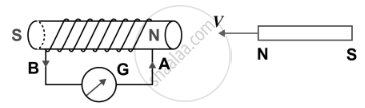 |
| (c) | 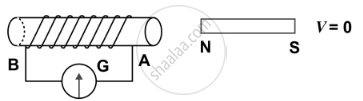 |
| (d) | 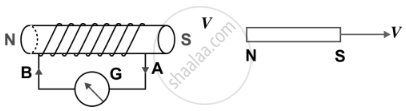 |
| (e) | 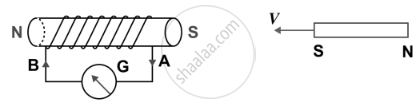 |
- When the magnet is stationary there is no deflection in galvanometer. The pointer read zero. [Fig. (a)]
- When the magnet with north pole facing the solenoid is moved towards the solenoid, the galvanometer shows a deflection towards the right showing that a current flows in the solenoid in the direction as shown in [Fig. (b)]
- As the motion of magnet stops, the pointer of the galvanometer comes to the zero position [Fig. (c)]. This shows that the current in the solenoid flows as long as the magnet is moving.
- If the magnet is moved away from the solenoid, the current again flows in the solenoid, but now in a direction opposite to that shown in [Fig. (b)] and therefore the pointer of the galvanometer deflects towards left [Fig. (d)].
- If the magnet is moved away rapidly i.e. with more velocity, the extent of deflection in the galvanometer increases although the direction of deflection remains the same. It shows that more current flows now.
- (vi) If the polarity of the magnet is reversed and then the magnet is brought towards the solenoid, the current in solenoid flows in the direction opposite to that shown in Fig. (b) and so the pointer of galvanometer deflect towards left [Fig. (e)].
APPEARS IN
संबंधित प्रश्न
Prove theoretically (electromagnetic induction) `e = (dphi)/(dt)`
Name a common device that uses electromagnets.
Name and state the law which determines the direction of induced current.
or
State Fleming’s right-hand rule.
Consider the energy density in a solenoid at its centre and that near its ends. Which of the two is greater?
The diagram 10 shows two coils X and Y. The coil X is connected to a battery S and a key K. The coil Y is connected to a galvanometer G.
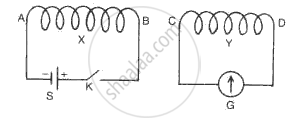
When the key K is closed. State the polarity
(i)At the end of the coil X,
(ii)At the end C of the coil Y,
(iii)At the end C of the coil Y if the coil Y is (a) Moved towards the coil X, (b) Moved away from the coil X.
What is an electromagnet?
What for an inductor is used? Give some examples.
A coil of 200 turns carries a current of 4 A. If the magnetic flux through the coil is 6 x 10⁻⁵ Wb, find the magnetic energy stored in the medium surrounding the coil.
How were electricity and magnetism considered for a long time?
What is produced when a magnet moves towards or away from a coil?
